Nikkei Rises on Bargain Hunting and KOSPI Recovery
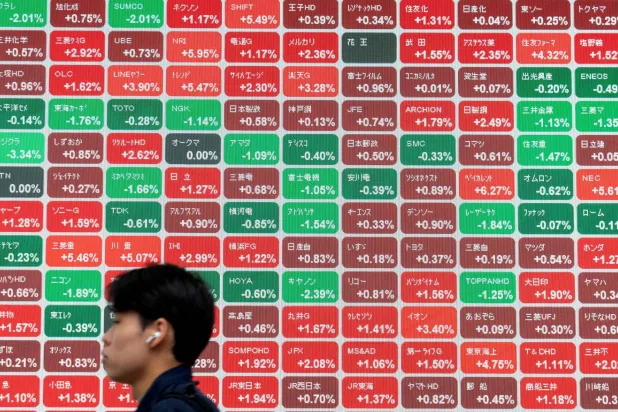
Japan's Nikkei stock index climbed on Tuesday, buoyed by bargain hunting and favorable sentiment from the South Korean market.
The Japanese Nikkei stock index rose on Tuesday, supported by bargain hunting and positive tailwinds from the South Korean market, which is dominated by the technology sector.
The benchmark Nikkei index gained 0.74 percent to close at 38,743.50 points, recovering from an earlier decline of up to 1.45 percent. The broader TOPIX index also rose 0.79 percent to 2,838.98 points. Stocks generally fell in the morning, pressured by the overnight decline in the U.S. market after renewed hostilities between the United States and Iran caused a sharp rise in oil prices. The Nikkei rose in the afternoon, coinciding with a recovery in the South Korean KOSPI index, as the correlation between the markets has recently strengthened.
Maki Sawada, an equity strategist at Nomura Securities, said: 'We are seeing some buying on price dips. Central bank policy remained in focus after Reserve Bank of New Zealand Chief Economist Paul Conway warned that rising oil costs could lead to persistent inflation, reinforcing signals of further monetary tightening in major economies.'
Shares of Mitsubishi UFJ Financial Group, Japan's largest banking group, rose 1.67 percent to reach an all-time high, making it the largest company in the domestic market by market capitalization.
Sawada added: 'With rising interest rates, there are expectations that banks' net interest margins will improve somewhat, which will lead to gains in the banking sector. The market's performance was generally positive, with 176 shares in the Nikkei index rising against 47 falling, while two remained unchanged.'
The top gainers were Shiseido, up 5.11 percent, followed by Kawasaki Kisen Kaisha, up 4.73 percent, and Tokuyama, whose shares rose 4.17 percent. The top losers were Yaskawa Electric, down 8.98 percent, followed by Panasonic Holdings, down 5.57 percent, and Toppan Holdings, whose shares fell 4.64 percent.
* Bond Rally
For their part, Japanese government bonds rose on Tuesday, driving the yield on 20-year bonds down by the largest margin in six months, as officials signaled potential changes to investment funds and increased demand for long-term debt.
The yield on the benchmark 10-year Japanese government bond fell 4.5 basis points to 2.740 percent. The yield on the 20-year Japanese government bond fell 16.5 basis points to 3.580 percent, marking its largest decline since January 21.
Yields move inversely to bond prices.
Finance Minister Satsuki Katayama stated that the government might consider adjusting asset allocations in Japan's massive pension funds if the investment environment undergoes sharp changes. Katayama also touched on the possibility of allowing Japanese government bonds to be included in tax-exempt individual investment accounts.
Separately, Health Minister Kenichiro Ueno said the ministry would study a review of the Government Pension Investment Fund (GPIF) asset allocation if necessary, but downplayed the significance of any near-term changes.
Takashi Fujiwara, senior fund manager at Resona Asset Management, said the Finance Minister's comments on individual investor purchases of Japanese government bonds improved the demand outlook for these bonds. The Ministry of Finance sold 700 billion yen ($4.31 billion) of 20-year bonds. The bid-to-cover ratio, an indicator of demand, rose to 4.52, the highest level since the April sale.
Takuya Onozawa, a fixed-income strategist at Mitsubishi UFJ Morgan Stanley Securities, said: 'The results were strong, even better than expected. The yield level is relatively high, which explains the strength of the demand.'
The yield on the 30-year bond fell 18 basis points to 3.725 percent, while the yield on the 40-year Japanese government bond, the longest maturity in Japan, fell 10 basis points to 3.795 percent. Meanwhile, the yield on the 2-year bond, which is most sensitive to Bank of Japan interest rates, fell 1 basis point to 1.435 percent. The yield on the 5-year bond also fell 4.5 basis points to 1.950 percent.
Original source: Asharq Al-Awsat


Comments (0)
Be the first to comment.