Saudi-US Nuclear Cooperation: A Pillar for the Kingdom's Economic and Industrial Transformation
وقعت السعودية والولايات المتحدة اتفاقاً للتعاون في الطاقة النووية السلمية يشمل ضمانات ثنائية، بهدف تنويع مزيج الطاقة وتعزيز الأمن الطاقي وفق أعلى المعايير الدولية.
Saudi-US relations have entered a new phase of strategic cooperation following the signing of an agreement on cooperation in peaceful nuclear energy (123 Agreement) along with a bilateral safeguards agreement, solidifying the legal framework for a partnership that spans decades. The agreement comes as the Kingdom moves towards diversifying its energy mix and enhancing its energy security in line with the highest nuclear safety and security standards.
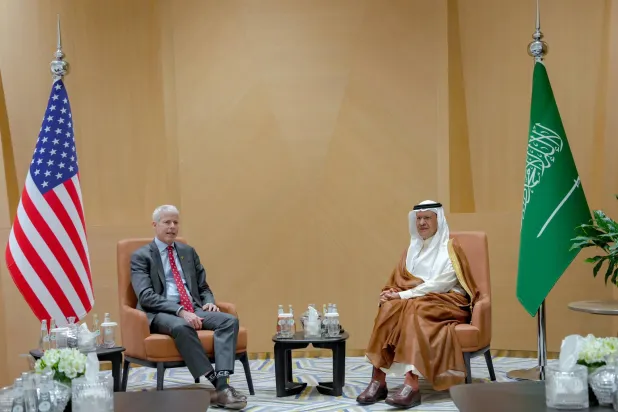
The agreement was signed by Prince Abdulaziz bin Salman, Saudi Minister of Energy and Minister of Industry and Mineral Resources, and US Energy Secretary Chris Wright, completing what was announced during the visit of Prince Mohammed bin Salman, Crown Prince and Prime Minister of Saudi Arabia, to the United States last November regarding the completion of negotiations on peaceful nuclear cooperation.
Abdulaziz bin Salman and Wright at KAPSARC (Ministry of Energy)
The Saudi Ministry of Energy said the agreement aims to enhance bilateral cooperation, support the exchange of expertise, knowledge, and technologies, contributing to the development of peaceful uses of nuclear energy in accordance with the highest international standards on nuclear safety, security, and non-proliferation. The agreement represents an extension of existing cooperation between the two countries in the energy sector and reflects their shared vision to expand partnership in energy, future technologies, and sustainable development.
For its part, the US Department of Energy said the agreement establishes the legal framework for a partnership spanning decades, valued at billions of dollars, to support meeting the Kingdom's energy needs. It added that the agreement enhances the common interests of both countries by expanding cooperation in civil nuclear technology and solidifying the strategic partnership between the two nations.
In a comment, Wright praised Prince Abdulaziz bin Salman, describing him as one of the foremost thinkers in global energy markets, with an independent vision and positions based on what he believes is right, away from political pressures. He said their relationship evolved from professional admiration to friendship and mutual trust, affirming that Prince Abdulaziz has principled leadership that contributed to building an efficient and innovative Saudi energy system. He also commended his role in empowering women in the energy sector, considering that what the Saudi Ministry of Energy has achieved reflects strong leadership combining firmness, generosity, and teamwork.
0 seconds of 0 secondsVolume 90%
Press shift question mark to access a list of keyboard shortcuts
00:00
00:00
00:00
The agreement was not the product of recent negotiations; talks on civil nuclear cooperation between Saudi Arabia and the United States date back to 2008, when the two sides signed a memorandum of understanding on cooperation in peaceful nuclear energy. Consultations continued in subsequent years, and between 2017 and 2019, there were talks with US companies interested in participating in the Saudi nuclear program, before the two countries signed a joint declaration in November 2025 to complete the cooperation framework, leading to the signing of the 123 Agreement and the bilateral safeguards agreement, which establish the legal framework for civil nuclear cooperation between the two countries.
The US Secretary of Energy had revealed this topic in an exclusive interview with Asharq Al-Awsat during his visit to the Kingdom in 2025, while Prince Abdulaziz bin Salman had announced that the Kingdom is moving towards benefiting from nuclear energy and its radiation applications for peaceful purposes, and continues to implement its national nuclear energy project with all its components, including the project to build the first nuclear power plant in the Kingdom.
0 seconds of 0 secondsVolume 90%
Press shift question mark to access a list of keyboard shortcuts
00:00
00:00
00:00
This step confirms the path announced by the Kingdom in recent years to develop its peaceful nuclear program. In his speech at the 69th General Conference of the International Atomic Energy Agency in Vienna in 2025, Prince Abdulaziz bin Salman emphasized that the Kingdom's project to build its first nuclear power plant, in cooperation with the Agency, aims to diversify the energy mix, enhance clean supplies, and achieve sustainable development, affirming Saudi Arabia's aspiration to be a model to be emulated in the peaceful uses of nuclear energy in accordance with the highest standards of nuclear safety and security.
What is the 123 Agreement?
The agreement is named after section 123 of the US Atomic Energy Act, which governs civil nuclear cooperation between the United States and other countries. Washington does not allow the export of reactors, fuel, or nuclear technology except to countries that enter into this type of agreement, which defines the legal framework for cooperation, oversight mechanisms, and requirements for the peaceful use of nuclear materials and technologies.
Under the agreement, US companies can participate in the design, construction, and operation of Saudi nuclear reactors, and supply equipment, fuel, and technical services, subject to all activities complying with non-proliferation obligations and International Atomic Energy Agency safeguards, in addition to the bilateral safeguards agreement signed between the two countries.
Importance of the Agreement: Economic and Strategic Dimensions
The nuclear agreement represents a strategic step in the transformation of the Saudi energy sector, supporting the diversification of the energy mix and enhancing supply security by introducing peaceful nuclear energy alongside natural gas and renewable energy. This enables more efficient electricity and water desalination production, reduces domestic reliance on oil and gas, and frees up larger amounts of hydrocarbons for export, boosting revenues, improving the efficiency of natural resource utilization, and supporting sustainable long-term economic growth.
The agreement also supports the goals of Vision 2030 aimed at diversifying energy sources and reducing carbon emissions, amid continuous growth in demand for electricity and water, and enhances supply security by providing a stable source of electricity independent of fuel market fluctuations.
On the industrial front, the agreement opens the door for US companies to participate in developing Saudi nuclear infrastructure, including the design, construction, and operation of reactors and supply chain development, along with knowledge and advanced technology transfer, increasing local content, qualifying national cadres, and promoting research and development, solidifying a sustainable Saudi nuclear industry.
Talks between the US and Saudi sides in Riyadh chaired by Wright and Prince Abdulaziz bin Salman (Asharq Al-Awsat)
The agreement gains additional importance due to its connection to the future of the nuclear fuel cycle in the Kingdom, amid Saudi Arabia's direction to invest in its domestic uranium resources and develop the nuclear value chain. The Kingdom has announced its intention to produce yellowcake as the first stage in the nuclear fuel cycle, as part of its plans to economically benefit from uranium resources and build an integrated peaceful nuclear sector. Prince Abdulaziz bin Salman also affirmed that the Kingdom aims to develop the complete nuclear fuel cycle for peaceful purposes, including exploiting national uranium ores in accordance with international safeguards and commitments.
A journey that began more than two decades ago
Original source: Asharq Al-Awsat



Comments (0)
Be the first to comment.