Raya Matta Rewrites the Biography of the White Shirt
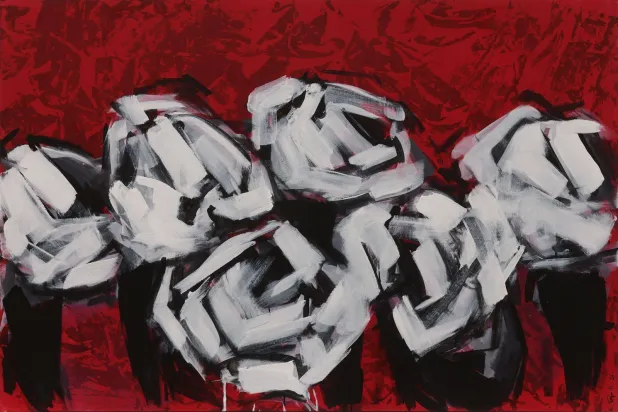
The larger the shirt grew, the more the body receded. And the more its forms repeated and accumulated, the more the individual lost their place in the composition...
Humanity gradually retreats before a white shirt that expands, detaches from the body, and takes over the canvas. It begins as a familiar element worn by a person, then turns into a mass standing on its own, while its bearer shrinks until disappearing. On this visual movement, Lebanese-Greek artist Raya Matta builds her solo exhibition 'Larger Than Us,' hosted by Maya Art Space in downtown Beirut, curated by art curator Randa Sadaka.
In the exhibition, Matta presents her latest series 'Power,' exploring the nature of authority, its allure, and its ability to alter the relationship between humans and the symbols they create. The idea centers on the white shirt, a garment associated in public consciousness with prestige, order, and professional and social status. From one painting to another, this familiar element becomes a symbol of power and an image of institutions that gain influence surpassing that of the people who founded them.
Not everything that swallows a person has a mouth (Maya Art Space)
The works do not rely on specific political figures or events to evoke power; rather, the artist builds it visually through the enlargement of masses, changes in size, and the skewed relationship between body and shirt. This shirt, the larger it grows, the more the body recedes. And the more its forms repeat and accumulate, the more the individual loses their place in the composition. Raya Matta avoids embodying power in particular individuals or events, leaving the sizes, voids, and proportions within the canvas to express it, as humanity retreats before the expanding shirt. Thus, the paintings reveal how the balance of the relationship between humans and power shifts until power becomes an entity in itself.
The new version might forget a little whom it used to imitate (Maya Art Space)
The wide spaces with limited colors allow the white shirt to dominate the scene. The contrast between white, gray, and black draws the eye, while quick dark lines impart a sense of instability, as if the forms are about to collapse or break loose. In a painting flooded with red, the conflict between the piled shirts and the surrounding emptiness intensifies, as the boundaries between body and clothing, individual and group, recede. Repetition serves the construction of the idea within the exhibition. It creates a sense of a system that reproduces itself, replicates its image, and squeezes what remains of the human imprint.
Things that do not look at us change us more than others (Maya Art Space)
Raya Matta is preoccupied with identity, memory, and the forces that affect human life—themes also linked to her Lebanese and Greek background. In 'Larger Than Us,' she focuses on power and how it can change an individual's relationship with themselves and others. As the symbol's presence expands within the paintings, the individual's presence recedes, and their position, value, and image become more subject to a system they cannot control.
Bodies appear in several works fragmented or trapped within the folds of shirts. In other works, the human appears tiny at the edge of the canvas, as if watching a massive construction they can no longer control. Matta does not need noisy scenes to speak about power. She places it before the eye as if it were a normal part of life, seeming to have existed from the beginning, without a moment of entry or announcement of itself.
At the end of every story, something remains that does not know it survived (Maya Art Space)
The white shirt is open to multiple interpretations. It can be associated with management, work, and professional classes, or with the official image that grants its wearer social legitimacy. It also carries an apparent cleanliness and discipline that do not remain at the level of appearance. Through this contradiction, the works avoid presenting power as absolute evil or an ideal state. They first reveal its attraction, then observe what it does to those who approach it.
Thus, the white shirt in Raya Matta's works stops performing its usual function. It leaves the wardrobe, the workplace, and the body as well, to begin another biography... a biography of a trace that remains after the scene ends, retaining what passed before it, while faces change and disappear.
Original source: Asharq Al-Awsat



Comments (0)
Be the first to comment.