Sharjah Ruler Launches Second Phase of Rhetorical Interpretation Encyclopedia and First Encyclopedia of Individual Qira'at Methodologies
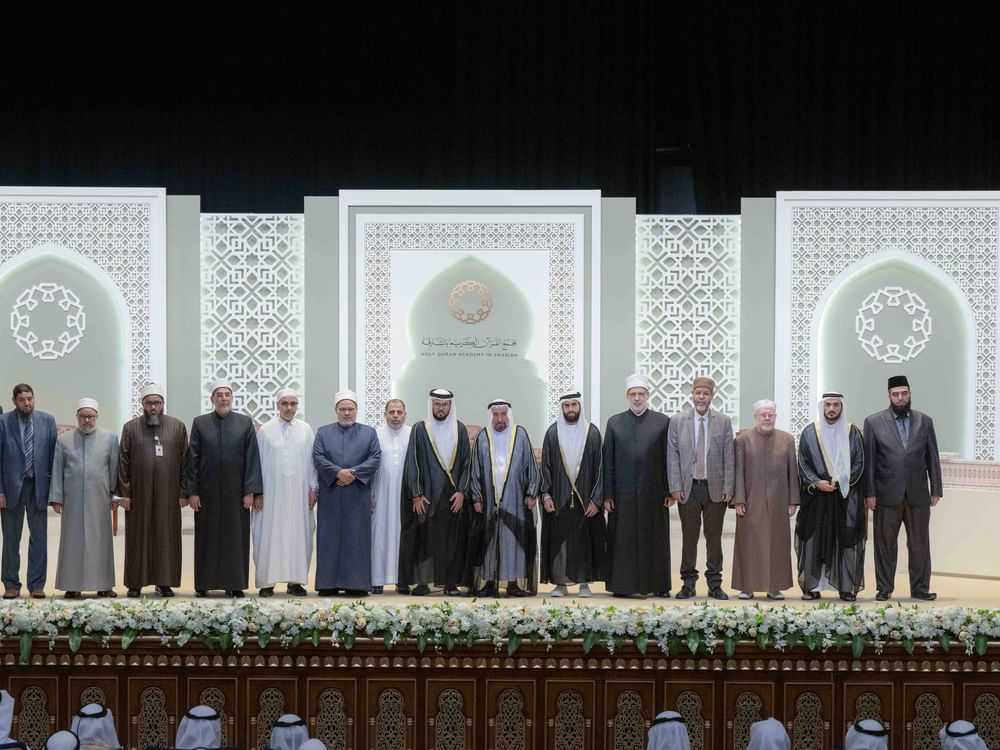
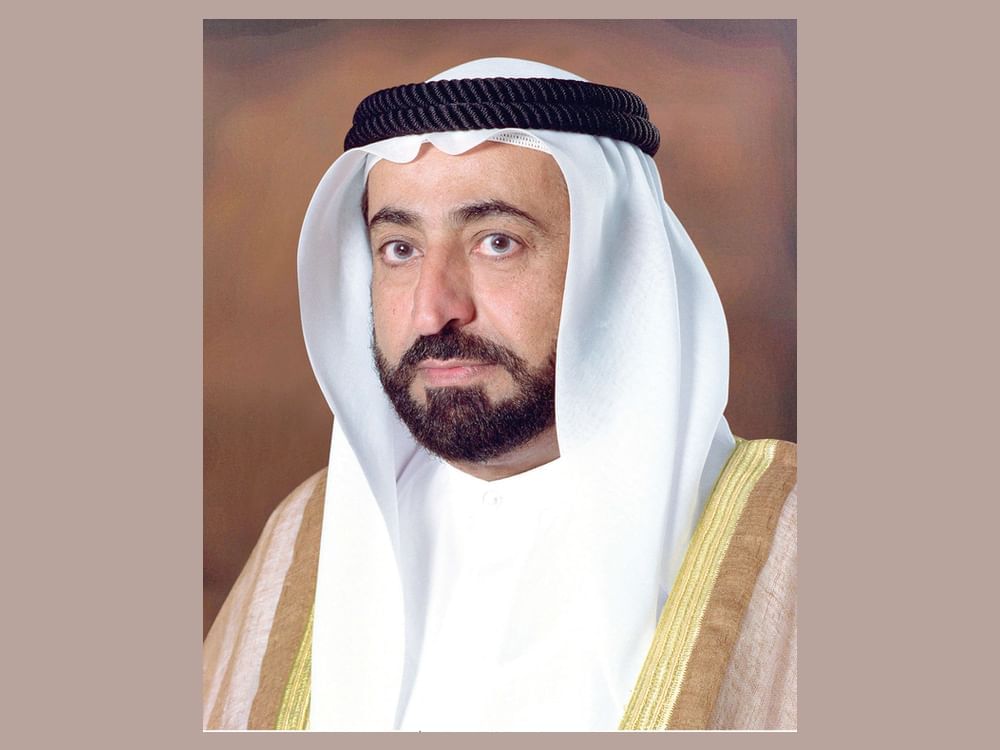
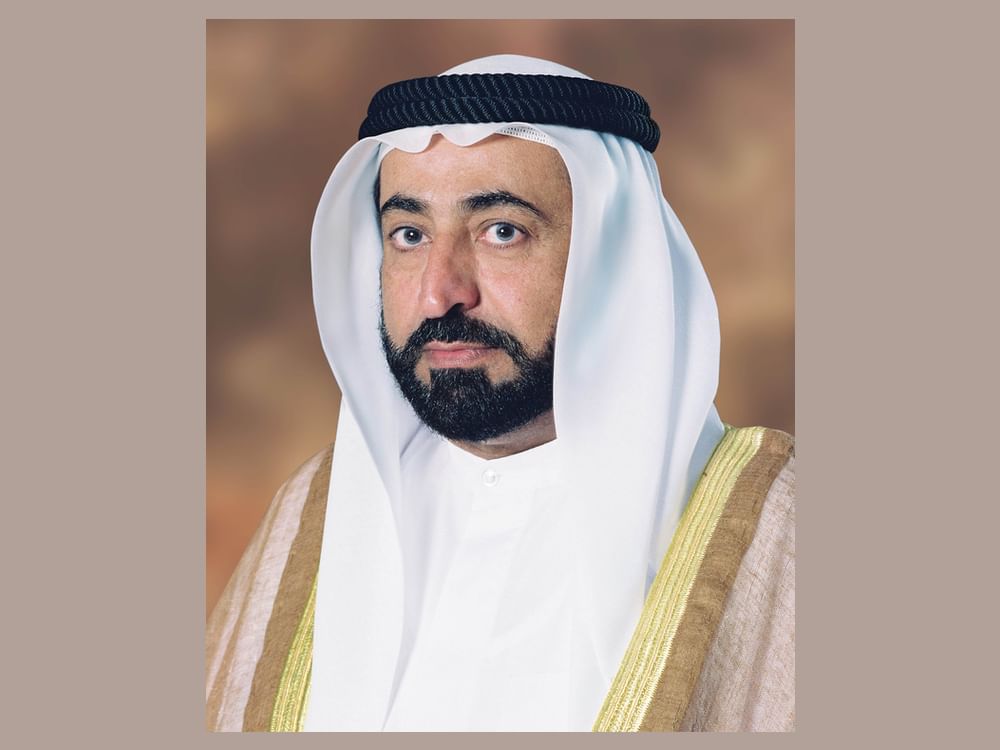
Sharjah, March 27 /WAM/ - His Highness Sheikh Dr. Sultan bin Muhammad Al Qasimi, Supreme Council Member and Ruler of Sharjah, launched this evening the second phase of the "Rhetorical Interpretation" Encyclopedia and the Encyclopedia of the Qalun 'an Nafi' Narration, the first of the Encyclopedias of Individual Qira'at Methodologies.
This occurred during His Highness's attendance at the annual graduation ceremony of the fourth batch of reciters (qurra') holding licenses (ijazat) from the Holy Quran Academy in Sharjah, numbering 249 recipients, held at the University City Hall in Sharjah.
His Highness the Ruler of Sharjah kindly signed the first copy of the volumes of the second phase of the "Rhetorical Interpretation" Encyclopedia, comprising 16 volumes, covering the second quarter of the Holy Quran, bringing the total number of volumes in both phases to 25 volumes. His Highness also signed the first copy of the volumes of the Encyclopedia of the Qalun 'an Nafi' Narration, the first of the Encyclopedias of Individual Qira'at Methodologies, consisting of 10 volumes, in addition to the Holy Quran with a marginal commentary on the Qalun 'an Nafi' al-Madani narration.
The Rhetorical Interpretation Encyclopedia is unique and unprecedented among interpretive rhetorical works, offering a comprehensive interpretation of the Holy Quran. It explains the meanings of vocabulary by providing precise and concise linguistic explanations of terms, referencing authoritative dictionaries, books on unusual Quranic words (Gharib al-Quran), and commentaries. It clarifies the overall meaning of verses in accessible language while ensuring well-structured, strong, and coherent phrasing, avoiding tedious elaboration or insufficient brevity, and paying attention to good organization and quality presentation.
The encyclopedia also addresses the occasion of each surah with what precedes and follows it, the occasion of each verse with what precedes it, and the connections and relationships between them, along with subtle points and nuances. It highlights linguistic and rhetorical clarification by examining the impact of linguistic styles on meanings, such as emphasizing the role of indefiniteness and definiteness, observing the meanings conveyed by conjunction and disjunction, demonstrating the suitability of brevity, equality, or amplification for the intended meaning, clarifying the harmony of wording with meaning, the wisdom behind the use of plural, singular, and dual, masculine and feminine, the implications of nominal and verbal sentences, and other topics of the science of meanings (ma'ani) that are among the most important means of revealing the beauties of the Quranic text and the precision of its verse arrangement.
The encyclopedia focuses on the types of verbal and rhetorical embellishments (badihi) that adorn the Quranic text, including the harmony of rhymes, the beauty of antithesis (tibaq), similarity of endings, the magnificence of gradation (taraqqi) in the order of meanings, and other features abundant in the Quranic verbal fabric.
The encyclopedia also highlights semantic differences between Quranic words, addresses verbal similarities, mentioning explanations and occasions, and points out the guidance of verses and the messages and signals embedded in their rhetoric. The encyclopedia relies on authoritative sources of interpretation, linguistics, and rhetoric.
The Encyclopedia of Individual Qira'at Methodologies is distinguished by its comprehensive coverage and thorough verification of every detail, great and small, related to Quranic narration. It addresses the words of the Quranic text (al-farsh), their enumeration, evidence, guidance, and performance notes. It also covers the foundational principles (al-usul) such as prolongations (mudud), plural meems, and others, however frequent, as reminders and for ease of students, with evidence, guidance, and performance notes. The encyclopedia is uniquely adorned with the mention of the Uthmanic script and Quranic diacritics for Quranic words, both in agreement and difference, facilitating for reciters the effort of searching in authoritative books on pause and start (waqf and ibtida') by mentioning every permissible pause noted by a scholar.
The Encyclopedia of Individual Qira'at Methodologies did not neglect to mention the verse-endings (fawasil) for each narration, given the scarcity of reciters addressing this art. It thus mentions the evidence and guidance for each disputed verse-ending. The crowning feature of this encyclopedia's merits is the chapter on subtle points of recitation (lata'if al-iqra'), the essence of the thoughts and experiences of esteemed reciters over many years of teaching and disseminating the Quran with its narrations.
The encyclopedia includes all schools of recitation without favoring one, leaving the field open for the reciter and his student to choose, aiming for the encyclopedia to be beneficial to the entire Ummah without excluding any school of recitation.
The encyclopedia is also distinguished by the issuance of a special Mus-haf for each narration, summarizing what is in the encyclopedia in terms of script and diacritics conforming to the Quranic narration, accompanied by an audio recording of the differences of the narration in all its aspects via a QR code, to preserve the correct oral transmission of the Quran's words, carried out by sheikhs distinguished by the beauty of recitation, along with precision, verification, and meticulousness.
The ceremony began with the recitation of clear verses from the Wise Remembrance. Subsequently, the reciter Uthman Hasan Yusuf granted his student, Haj Murad Muhammadov, a student of the Holy Quran Academy in Sharjah, a Quranic license. With the license he obtained from the academy, Muhammadov granted his student, Muhammad Bashir from the Russian Federation, a license, in a scene depicting the fruit of the fruit, the succession of khatmas and licenses and their spread, embodying the Academy's mission to consolidate and transmit Arab and Islamic identity to countries worldwide.
Dr. Khalifa Musbeh Al Tunaiji, Head of the Holy Quran Academy in Sharjah, delivered a speech in which he expressed profound gratitude and immense appreciation to His Highness the Ruler of Sharjah for his unlimited support for serving the Holy Quran and its people in general, and for the Holy Quran Academy and its scientific and research projects in particular, until it became a global specialized scientific beacon.
Al Tunaiji said: "The Holy Quran Academy has achieved qualitative achievements, with the electronic Sharjah Quranic Assembly covering 170 countries worldwide, and the number of khatmas reaching 1,246 by the end of 2023, including both individual and combined recitations, received by graduates from a selection of competent reciters. The number of students benefiting from the Academy's programs reached 768, and the total number of Quranic licenses granted to students who passed the chain of transmission (sanad) test reached 1,210 licenses."
He added: "Today we celebrate the graduation of the fourth batch of license holders, numbering 249, coming from various continents of the world. Congratulations to them on this lofty status and divine selection."
Regarding the scientific studies and research conducted by the Academy, Al Tunaiji said: "The Academy pays great attention to scientific studies and research related to the Holy Quran and its sciences. It has issued the second phase of the Rhetorical Interpretation Encyclopedia, which focuses on the rhetoric of the Holy Quran in detail with a unique methodology, employing rhetorical purposes to serve the Quranic text. Forty scholars contributed to it, and 14 parts of the Quran have been completed, totaling 25 volumes as of March 2024, with more than 56,000 rhetorical entries. The total expected volumes at the end of the project will reach 50 volumes. In addition, there is the project of Individual Qira'at Methodologies, which is distinguished by its comprehensiveness and detailed exposition of the science of Qira'at in all its branches and sciences, amounting to about 150 volumes. The Encyclopedia of the Qalun 'an Nafi' Narration has been completed, containing 10 volumes, in addition to a Mus-haf explaining the narration and a Mus-haf of Qalun 'an Nafi' with Eastern diacritics alone, which is the first publication of the Individual Qira'at Methodologies, with 27 scholars contributing."
Original source: WAM



Comments (0)
Be the first to comment.