"Temporary Darkness in Broad Daylight" .. Rare Astronomical Event in Saudi Arabia Early Next Year

Listen to the article Audio text automatically generated by an automated system
0:00
Two minutes to read
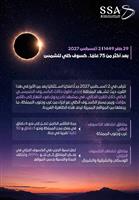
Saudi Arabia is set for a rare astronomical event not seen in its skies for over 75 years, as it will witness one of the longest total solar eclipses of the current century, a rare celestial sight that turns daylight into temporary darkness in some parts of the country.
The Saudi Space Agency said that "the solar eclipse paths intersect large parts of western and southern Saudi Arabia, giving it a distinct advantage and strategic location on the global astronomical observation map to monitor and document this phenomenon, while the maximum duration of the total eclipse is expected to be recorded over neighboring Egyptian territory."
The Saudi Space Agency explained that residents and visitors of the western and southern regions of the Kingdom will have a date with a total view of the eclipse, as the duration of blocking sunlight and total darkness will reach about 6 minutes in some southern areas such as Abha city, while Jeddah governorate and areas on the western coast will record a blocking duration of up to approximately 5 minutes and 50 seconds — relatively long periods that give researchers and astronomy enthusiasts a golden opportunity to study the solar corona.
In a related context, a report published by the Saudi Press Agency stated that the rest of the country's regions (central, eastern, and northern) will not be isolated from this event, as they will witness a partial eclipse of the solar disk with varying percentages, with the blocking ratio reaching up to about 80% in some areas. The duration of the eclipse, the percentage of blocking, and the exact timing of its start and end vary precisely according to the geographical coordinates and location of each region and governorate.
The Saudi Space Agency emphasizes the utmost importance of following safety and security guidelines while observing the phenomenon, stressing the need to avoid looking directly at the sun without using glasses and binoculars equipped with special filters, to ensure everyone's safety and a safe observation experience.
Ad material
Ad material
Read also
Saudi Space Agency launches 'Sari 2' initiative to develop satellites, based on a set of strategic goals including developing skills and supporting Saudi research
Saudi Space Agency to Al Arabiya.net: Our space missions yielded 19 scientific experiments; 33 billion riyals size of space economy in Saudi Arabia
King of Malaysia discusses cooperation in aviation and space industry in Saudi Arabia; Malaysian monarch Sultan Ibrahim Iskandar and his delegation visited SAMI ... Saudi Arabia
Original source: Al Arabiya



Comments (0)
Be the first to comment.