Iranian Students Take Exams Under the Weight of War
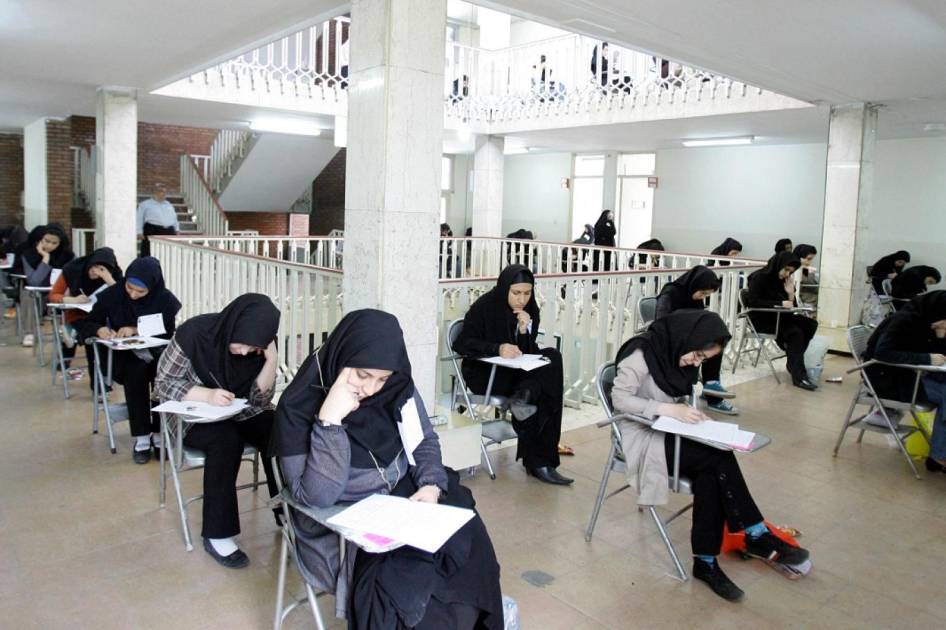
Summary: The provinces of Fars, Ahvaz, and Tehran contain the largest number of exam centers, making Ahvaz, one of the recent military flashpoints, second in the country in terms of educational centers. Yet the Ministry of Education did not exempt it from holding exams.
After being canceled last June due to war conditions, final exams for 11th and 12th graders in Iran began on Sunday, July 12, after a delay of about two months, at a time when the Ministry of Education ignored demands from thousands of students and their families to postpone the exams.
Students and their families justified their demands for postponement with a number of reasons, including weeks of school stoppages, internet outages, problems with remote learning, the inclusion of 60% of the high school GPA in the university entrance exam result, along with the spread of buying and selling exam questions, and the proximity of some exam centers to military sites amid the resumption of war.
Students in southern provinces face even more worrying conditions. Several of them wrote on social media that they spend their nights to the sound of continuous explosions and rockets, then head to exam halls in the morning suffering from severe anxiety, having completely lost their ability to concentrate.
Over the past weeks, 11th and 12th graders launched several campaigns demanding a postponement of the exams, but Ministry of Education officials insisted that time constraints before the university entrance exam and educational planning considerations do not allow rescheduling.
With the war ongoing, and as government offices and banks close in some provinces, including Hormozgan, students are still forced to go to exam halls despite continuous explosions. Families fear a repeat of the Minab school tragedy that occurred during the 39-day war.
School Closures and Challenges of Remote Learning
The 2025-2026 academic year in Iran ended after schools experienced repeated closures for a large part of the year due to war conditions, air pollution, and the energy crisis. Despite the Ministry of Education repeatedly affirming that classes would continue online, widespread malfunctions affecting the "Shad" platform (Student Education Network) and the long internet outage made remote learning almost impossible.
This, combined with the psychological pressures of the war, led many students to disengage from studying, leaving them today facing final exams without adequate preparation. The situation is even more dangerous because these exam results constitute 60% of the university entrance exam score and 50% of the teacher training university entrance exam score, making them a decisive factor in determining students' futures.
The inclusion of the high school GPA in the university entrance exam result was one of the main reasons for public demands to postpone the exams. This decision, approved by the Supreme Council of the Cultural Revolution, sparked widespread objections before its adoption, but the Ministry of Education today refuses to show any flexibility in rescheduling the final exams, despite its direct impact on students' futures.
Zahra Nazari, Deputy Director of Secondary Education in Lorestan Province, said the decision to hold exams during the current July and next August was made by higher authorities, claiming that arrangements were made to ensure students attend exam halls in suitable conditions without worry.
But it is unclear what these arrangements entail, as field reports indicate that a number of students were absent from exams, while others submitted blank papers due to psychological pressures or lack of adequate preparation.
Ehsan Azimi Rad, a member of the Education Committee in the Iranian Parliament, pointed to this phenomenon in a post on platform X last Saturday, saying: "The first day of final exams for the 11th and 12th grades ended, but the level of tension, leaving exam halls with blank papers, and cases of insecurity, especially in southern regions, were very high and widespread, in addition to conflicting reports of cheating and leakage of some exam questions."
In contrast, Abdolreza Fooladvand, head of the Evaluation and Quality Assurance Center at the Ministry of Education, denied the validity of concerns about holding exams in southern provinces, students submitting blank papers, or the possibility of cheating or question leakage. He asserted that no problems occurred during the exams, claiming that the absentee rate for this year's exams is the lowest compared to last year.
Meanwhile, the ISNA news agency quoted the High Examination Committee as saying that the final exams during the first two days were conducted in an atmosphere of calm and reassurance, with broad student participation and support from their families at various exam centers across the country.
Buying and Selling Exam Questions via Telegram Channels
The High Examination Committee affirms that it has imposed strict oversight on the final exams to prevent any violations. According to officials, placing question writers in isolation, sending question files electronically in encrypted formats, using monitoring devices including signal detectors, in addition to continuous monitoring of all implementation stages, prevented any communication between students and those outside exam halls, which, in their view, makes claims of question leaks or prior disclosure baseless.
The Ministry of Education has repeatedly stressed that these measures have fully ensured exam security, and that all announcements circulating on social media and messaging apps under the title "Selling final exam questions" are nothing but scams targeting students. The Cyber Crime Police and the Measurement and Evaluation Organization claim that final exam questions cannot be accessed under any circumstances before the exam starts.
However, coinciding with the start of exams, dozens of channels on the Telegram app have emerged, widely promoting the sale of questions, claiming they can provide students with them hours or even minutes before the exam, for sums up to several million tomans.
Searching for the phrase "final exams" on Telegram reveals a long list of such channels, indicating a thriving black market on the sidelines of final exams in Iran.
In one case, a teenage girl, who paid about 80 million tomans (about $530) to the manager of a Telegram channel about eight hours before the 12th grade math exam, wrote that she has no guarantee of getting the genuine questions by the promised time, but she had no other choice because she had received a preliminary acceptance at a university outside Iran and must send her transcript to that university within a month by any means.
Proximity of Exam Centers to Military Sites
Original source: Independent Arabia


Comments (0)
Be the first to comment.