Jaljilya Village in West Bank: Emigrant Homes Constant Target of Settler Attacks
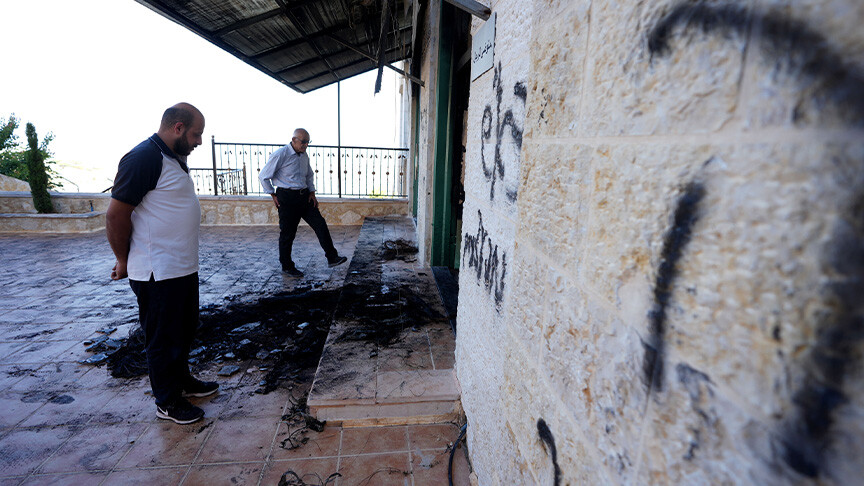
RAMALLAH / Qais Abu Samra / Anadolu
- Youssef Muzhir, a resident of the village: The settlers established outposts on the hills surrounding Jaljilya's lands, and since then attacks have escalated.
- Wahid Youssef, a resident of the village: Despite their lives abroad, the villagers do not think of giving up their land. I wish every Palestinian expatriate would return to his land and home.
- Ghazi Bakri, former head of Jaljilya Village Council: About 90 percent of the villagers hold American or Brazilian citizenship in addition to Palestinian.
In the village of Jaljilya, north of Ramallah city, in the central occupied West Bank, the picture differs from many Palestinian villages. The luxurious stone houses scattered on the slopes of the town and its vast gardens give the visitor the impression of a village full of life, but behind closed doors lies another story.
Most of these houses are uninhabited for most of the year, as their owners live in the United States or Brazil. Most of them hold, in addition to Palestinian citizenship, the citizenship of the country they emigrated to, and they only return to their village during summer or winter holidays.
Settler Attacks
This calm has dissipated in recent months with the escalation of settler attacks that targeted the village's homes, farms, and livestock. The foreign citizenship of many residents turned into just a document that did not provide them protection, while they found themselves facing one choice: return to their land and defend it.
Activist Ghazi Bakri, former head of Jaljilya Village Council, told Anadolu that the town's population is about 4,000, while only about 700 citizens reside there permanently.
He added that about 90 percent of the town's residents hold, in addition to Palestinian citizenship, American or Brazilian citizenship, as a result of waves of migration that began in the late Ottoman era and expanded after the 1948 Nakba and then after the occupation of the West Bank in 1967.
Bakri pointed out that the early migrants managed to obtain American citizenship before migration expanded through family reunification, turning over time into a social phenomenon, while most of the town's residents maintained their close relationship with their land and built large houses they return to on vacations.
He added that most of these houses remained empty most of the year, and their owners only visit for short periods, making them a repeated target for settler attacks.
They Want Us to Emigrate
One of the villagers, Youssef Muzhir, told Anadolu that he bought a piece of land and built his house about a year ago, but since moving to live in it, he found himself in direct confrontation with Israeli settlers.
Muzhir added that the settlers "established outposts on the hills surrounding the lands of Jaljilya, Sinjil, and al-Mazra'a al-Sharqiya, and since then attacks have escalated, including burning property, opening fire, and stealing sheep, in an attempt to force Palestinians to leave their lands."
He pointed out that "about 70 percent of the village houses are not inhabited by their owners because they reside in the United States, while the number of permanent residents does not exceed 500 to 700 people."
Muzhir continued that the settlers "repeatedly graze their sheep next to his house and assault his property," noting that "everything we work hard on, they try to destroy until we leave our land and emigrate."
Muzhir recounted an incident where two of his sons, one aged 13, were arrested after throwing stones at settlers' sheep that had entered the family's land, explaining that the Israeli police "arrested them, then imposed house arrest and a suspended fine."
He added that his house "was among the first houses to be targeted; settlers burned parts of it, fired bullets at it, stole agricultural tools and equipment, broke surveillance cameras, and despite filing complaints with the Israeli police, they yielded no results."
Useless Promises
For his part, Wahid Youssef, a villager holding American citizenship, said that "what the residents are suffering from at the hands of the settlers is inhumane," noting that "American citizenship did not protect homeowners from settler attacks."
He told Anadolu that the settlers "break, steal, and destroy everything in front of them, and they have no humanity," considering the goal of these attacks is "to force Palestinians to leave."
Youssef indicated that he "contacted the U.S. Embassy and officials in the United States, and got appointments and promises, but nothing changed on the ground."
He affirmed that the villagers, despite their lives abroad, do not consider giving up their land, saying: "I wish every Palestinian expatriate would return and take care of his land and home."
Youssef added that his house, which is the fruit of many years of work, "has become threatened daily, and he cannot leave it for several days for fear of vandalism or theft," noting that settlers "even attacked the workers who were working on it."
He continued: "Even if we suffer a hundred attacks, we will not give up our land. This is the land of our fathers and grandfathers, even if the price is our lives and the lives of our children."
Israeli Escalation
The settler attacks on Jaljilya come as part of an Israeli escalation in West Bank villages, which includes burning homes, vehicles, and agricultural lands, and assaulting Palestinians, especially in areas adjacent to settlements and outposts.
According to a report issued by the Wall and Settlement Resistance Commission on July 6, settlers committed 3,488 attacks during the first half of this year, including attacking Palestinian villages, burning homes, opening fire, seizing lands, and establishing outposts, resulting in the killing of 17 Palestinians.
About 750,000 settlers live in 141 settlements and 224 outposts in the West Bank, including 250,000 in East Jerusalem. Palestinian authorities and human rights organizations accuse settlers of carrying out daily attacks aimed at forcibly displacing Palestinians and seizing more land.
This comes as the West Bank has witnessed an escalation in attacks by the Israeli army and settlers since October 2023, which, according to official Palestinian data, has resulted in 1,179 Palestinians killed and 12,666 wounded, in addition to the arrest of about 24,000 Palestinians.
Original source: Anadolu Agency



Comments (0)
Be the first to comment.