Hundreds Hospitalized Due to 'Catastrophic' Heatwave in Japan
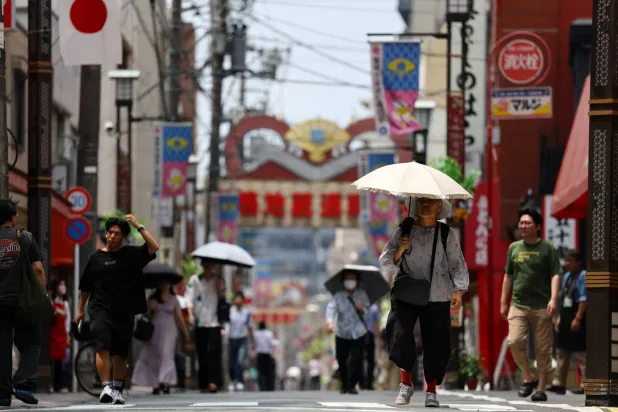
More than 450 people in Tokyo were hospitalized in a single day for treatment of heatstroke-related issues, a record high since data collection began 16 years ago, emergency services said Thursday.
The figure was released as Japan experiences a heatwave that has killed at least 14 people over the past week, according to AFP.
Some 453 people were hospitalized on Wednesday due to heat-related issues, the highest number since data collection began in 2010, according to the Tokyo Fire Department. The number of emergency service calls also reached its highest level since at least 1963.
A spokesman for the fire department told AFP: 'We urge people to drink enough water and use air conditioners.'
He explained that the number of patients rises with temperatures, noting significant increases on Tuesday and Wednesday.
In Tokyo prefecture, home to about 14 million people, one person has died from the current heatwave, while four are in critical condition and 18 are in serious condition.
American tourist Nick Estes, 35, who was visiting Tokyo's Asakusa district with his family, said the weather on Thursday was 'very hot.'
He told AFP: 'We plan our trips so that we can spend some time in the subway to escape the heat, and look for small shops we can enter, maybe to buy a simple souvenir that has air conditioning. We do everything we can to stay cool.'
He added: 'But especially with children, it's extremely difficult... I was here last summer and it seems hotter this year than last year.'
The Fire and Disaster Management Agency described the heatwave as a 'catastrophe' and announced on Wednesday that at least 14 deaths were recorded across the country last week, while 11,000 people required emergency medical care.
A fast-food worker tries to cool a person by spraying water on his head during a severe heatwave in Tokyo on July 22, 2026 (Reuters)
'Catastrophe'
In Aichi prefecture (central Japan), one of the areas hardest hit by the heatwave, 116 people were taken to hospitals on Wednesday, according to officials.
Heatstroke warnings have been issued across most of the country, which has a population of about 125 million.
The disaster agency said: 'Temperatures have been rising since mid-July, and the intense heat is expected to continue nationwide.'
It added that 'calling this extreme heat a catastrophe is not an exaggeration, as many people are being taken to hospitals or even dying from heatstroke.'
On Thursday, at least six areas recorded temperatures of 40°C or more by afternoon, while temperatures rose to 39.9°C in three other locations.
Hamamatsu in Shizuoka prefecture (central Japan) was the hottest, with a temperature of 41.1°C.
It was followed by Toyota City, home to the giant automaker, in neighboring Aichi prefecture, where the temperature reached 40.8°C, and Kuwana in Mie (40.7°C).
The highest temperature ever recorded in Japan was on August 5, 2025, in Isesaki, north of Tokyo, at 41.8°C.
This year, Japan introduced a new term for temperatures exceeding 40°C: 'kokushobi,' which translates to 'extremely severe hot day.'
The new term aims to draw more attention to heat-related warnings, although it does not trigger any official nationwide measures.
'The heat is increasing'
Scientists say that human-induced climate change is increasing the frequency and intensity of severe heatwaves in Japan and elsewhere.
Japan recorded its hottest summer on record last year.
Yesenia Goita, 47, visiting Japan from Los Angeles, said: 'You leave the hotel at 8:30 a.m.... you feel like it's noon. As the day goes on, it gets hotter and hotter.'
She added: 'Now I understand why (Japanese) clothes are loose and why they carry umbrellas all the time. The situation is very intense.'
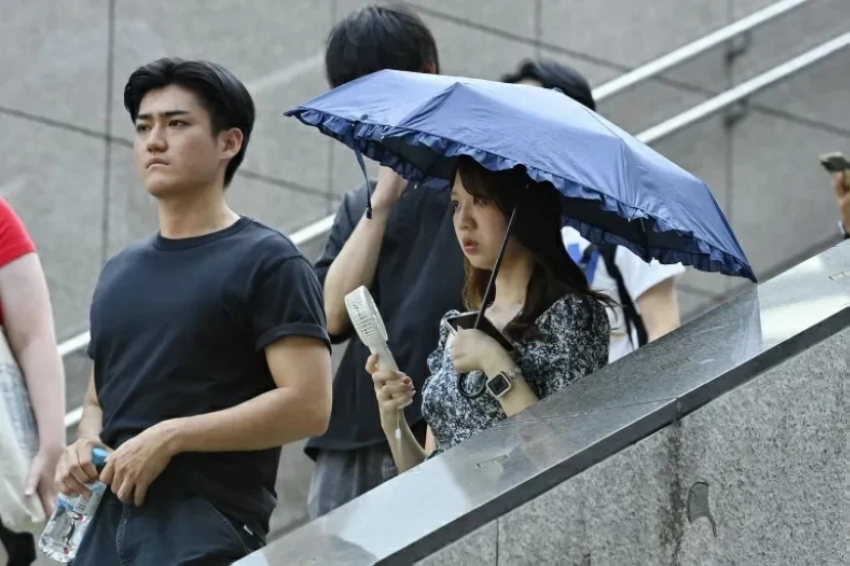
Japanese student Nakushima, 24, said: 'Since it's like this in mid-July, I don't know what will happen in August. I'm worried... I carry a large fan fully charged so I can use it at any moment.'
A huge fire ravages a forest area near Lège-Cap-Ferret and the Arcachon Basin in France's Gironde department amid worsening drought after a heatwave and water shortages in most of France on July 23, 2026 (Reuters)
Violent wildfires in Europe
Meanwhile, violent wildfires fueled by strong winds and high temperatures continue to sweep across several areas in southern Europe, particularly in Italy, Spain, and France, where authorities on Thursday had to evacuate thousands more people from a tourist area.
The fires have killed three firefighters, two in France and one in Italy.
Data from EFFIS satellite system analyzed by AFP shows that the current year so far ranks second in terms of area burned by wildfires in the European Union over the past two decades.
Forests are more prone to ignition due to the severe drought that has affected vegetation and soil for months, a drought worsened by the exceptional heatwaves that hit the continent in June and July.
An international team of scientists confirmed on Thursday that human-induced climate change has exacerbated the severe drought affecting Europe and contributed to record temperatures.
In southwestern France, firefighters continue to battle two major fires, one of which has burned more than 2,000 hectares north of the Arcachon Basin in Gironde, a popular tourist area near Bordeaux. No casualties have been reported so far.
Gironde authorities on Thursday evacuated at least 7,000 people as a precaution, bringing the total number of residents and tourists who had to leave their homes and accommodations to 12,000. The evacuation included six tourist campsites and a nudist residential complex north of Cap Ferret.
The other fire, which broke out in a field on Tuesday afternoon, is burning in the Var department in southeastern France, has consumed about 2,500 hectares, and led to the evacuation of about 400 people.
Franck Graziano of the fire and rescue service in Var said: 'The day is fraught with risk, as we expect temperatures inland to reach 45°C, with winds strengthening early in the afternoon to 60 kilometers per hour.'
French Interior Minister Laurent Nunez said that more than 12,500 fires have broken out in the country since the beginning of the year, burning about 44,000 hectares, an area larger than that burned in 2022, when southwestern France experienced large-scale fires.
Nunez was speaking from a fire station in Bordeaux after meeting the families of two firefighters killed on Tuesday while battling a fire near the city's airport.
A team from the civil protection sprays tourists with a water cannon at the Colosseum during a hot day in Rome on July 16, 2026 (EPA)
Over 40°C in Italy
Original source: Asharq Al-Awsat



Comments (0)
Be the first to comment.