The Nuclear Dragon Sleeps... For Now
Summary: The Pentagon does not rule out equipping a small number of ground-based missiles with nuclear warheads during exercises. The Pentagon estimates that China's arsenal will exceed 1,000 nuclear warheads by 2030, and it is likely that some will be deployed at "higher readiness levels."
The nuclear dragon sleeps, but for now, or for an unknown time. This was confirmed by the 2026 report on China's nuclear arsenal, as the modernization process of China's nuclear arsenal has seen notable acceleration and expansion in recent years. Experts at the Bulletin of the Atomic Scientists estimate that China currently possesses approximately 620 nuclear warheads, with more under production to arm future launch systems.
It is well known that China currently possesses the fastest-growing nuclear arsenal among the nine nuclear-armed states. It is the only country among the signatories to the Nuclear Non-Proliferation Treaty that is significantly increasing its nuclear arsenal.
The Past Decade Despite a notable and tangible increase in its nuclear activity over the past decade, all intelligence reports from U.S. government agencies, scientific sites, and informed media have clearly indicated that China has not changed its nuclear war doctrine since the beginning of its nuclear activity to date. Over the past decade, Beijing has significantly expanded its ongoing program to modernize its nuclear arsenal by deploying more types and numbers of nuclear weapons than ever before.
Since the release of the last Bulletin of the Atomic Scientists report on China in March 2025, China has continued to develop three new missile fields for launching solid-fuel intercontinental ballistic missiles, and has continued building new silos for its liquid-fuel DF-5 intercontinental ballistic missiles. Meanwhile, according to the 2026 Nuclear Notebook of the Federation of American Scientists, China has developed new versions of these missiles and advanced strategic launch systems, and has likely produced surplus warheads for use in these systems after deployment.
Pentagon Sources In 2025, the Pentagon reported that China's nuclear stockpile "remained at around 600 warheads until 2024, reflecting a slowdown in production rates compared to previous years." The main limitation of these Chinese warheads is that they are not "operationally ready," unlike U.S. and Russian nuclear warheads deployed on active missiles and at bomber bases worldwide. It is believed that all Chinese warheads are stored separately from launch platforms.
Nevertheless, the Pentagon does not rule out equipping a small number of ground-based missiles with warheads during exercises. The Pentagon estimates that China's arsenal will exceed 1,000 nuclear warheads by 2030, and it is likely that some will be deployed at "higher readiness levels." It is noted that the Pentagon's 2025 report to Congress, as in 2024 and 2023, did not include the projections in earlier U.S. Department of Defense reports stating that China could have a stockpile of around 1,500 nuclear warheads by 2035. Those projections were issued by the department in 2022.
Ballistic Missiles at Sea and in the Air It is clear that China focuses on possessing a striking ballistic force, so it "has also expanded its fleet of DF-26 dual-capable medium-range ballistic missiles, which appear to have completely replaced DF-21 medium-range missiles in the nuclear role."
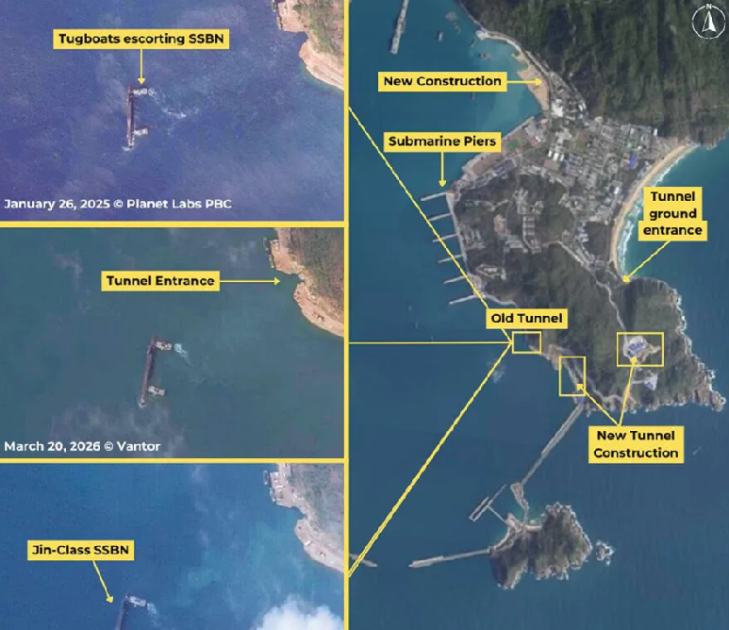
At sea, China is upgrading its Type 094 nuclear-powered ballistic missile submarines, equipping them with JL-3 long-range submarine-launched ballistic missiles, and constructing additional Type 094 submarines, along with a new class known as Type 096.
Furthermore, China has recently recommissioned some of its H-6 bombers for an operational nuclear mission; these bombers are equipped with air-launched ballistic missiles that may carry nuclear warheads. Nuclear weapons experts in this context emphasize that it is important "to see to what extent this expansion will affect China's nuclear policy and its strategy for using nuclear weapons."
Potential DF-26 medium-range missile brigades (Google Earth)
In an article titled "Chinese Nuclear Weapons, 2026" by Hans M. Kristensen, Matt Korda, Eliana Johns, and Mackenzie Knight-Boyle, published on July 8, 2026, the scientists also addressed U.S. estimates and assumptions regarding China's nuclear forces, providing a detailed explanation of fissile material production and Chinese nuclear tests, as well as providing estimated numbers for land-based ballistic missiles and other modern Chinese nuclear weapons.
Perhaps the most important takeaway from these various reports on China's nuclear program is that China's nuclear doctrine and policy have not changed much for decades. The Nuclear Notebook report in this context emphasized the stability and firmness of China's nuclear doctrine compared to other countries, despite the increase in Chinese nuclear activity. Thus, "all this data is not necessarily evidence of an official shift toward a more aggressive nuclear posture. It is also possible that the goal is to enable China to deploy its forces and launch them quickly when needed."
Submarines and Sea-Based Ballistic Missiles Regarding China's naval force, the report confirmed that China currently has a fleet of six Jin-class (Type 094) second-generation nuclear-powered ballistic missile submarines, stationed at the Yalong naval base near Longpo on Hainan Island. It is believed that "the latest two submarines of this class are improved versions of the original Type 094 design," while some Chinese magazines refer to them as Type 094A, but neither the Pentagon nor the Chinese government has confirmed this.
Read more China approaches completion of 'nuclear triad' amid US preoccupation How did Beijing develop its 'strategic shield' away from Western eyes? China and the United States heading toward nuclear catastrophe Who are America's new competitors in the global arms race?
According to the American atomic scientists, these submarines are distinguished by a larger bulge at their bow, which initially sparked speculation about their ability to carry up to 16 submarine-launched ballistic missiles instead of the usual 12. However, satellite images later confirmed that the new submarines are equipped with 12 launch tubes each, and subsequent updates showed that the bulges are related to sound-dampening equipment rather than the number of missiles.
Bombers According to the scientists' article on the Bulletin of the Atomic Scientists website, China has developed several types of nuclear bombs and used aircraft to deliver at least 12 of the nuclear bombs it detonated in its nuclear test program between 1965 and 1979. "Later, the nuclear mission of the People's Liberation Army Air Force ceased with the development of missile forces, and the utility and effectiveness of old medium-range bombers declined in the event of a nuclear conflict."
Original source: Independent Arabia





Comments (0)
Be the first to comment.