9 Members of Iranian Kurdish Opposition Killed in Iranian Strike in Iraq
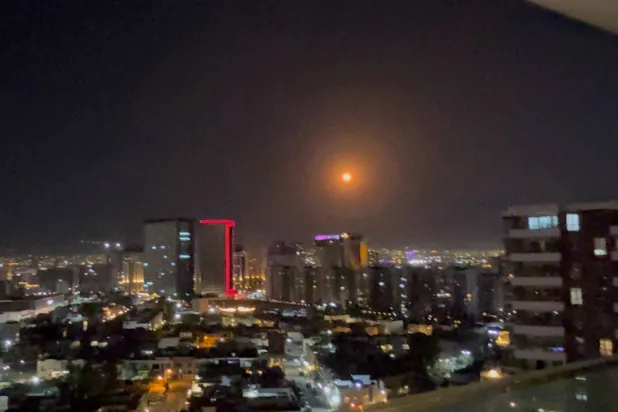
Nine members of an Iranian Kurdish opposition party were killed in an Iranian strike early Friday on their camp in the Kurdistan Region of northern Iraq.
Israeli forces, which control large areas of the Gaza Strip, have recently taken field measures paving the way for the implementation of the 'Peace Council' plan, which involves transferring Palestinians unaffiliated with Hamas to humanitarian zones in the devastated Rafah, which has been under full Israeli control for nearly two years.
Iron Gates
Residents of Mawasi south of Khan Younis and north of Rafah in the southern Gaza Strip were surprised Friday morning by Israeli forces installing a gate on the coastal Rashid Road in the 'High Class' area of Rafah Mawasi, amid a deployment of vehicles in that area, firing at anyone approaching the gate.
Palestinians mourn a victim killed in an Israeli strike in Gaza City on Thursday (Reuters)
According to a field source speaking to Asharq Al-Awsat, this is the second gate installed by Israeli occupation forces in the Rafah Mawasi area, after placing another days ago in the Shakoush area.
The source explained that these two gates lead to areas west of Rafah, specifically the Tel al-Sultan neighborhood and surrounding areas, noting that Israeli forces recently dug a trench in the Rafah Mawasi area, apparently aimed at preventing Palestinians from approaching those forces, if they are actually transferred to the area being discussed for living.
The source did not rule out that these gates would later be used to search Palestinians and verify their identities when they move to the area under discussion.
Tel al-Sultan
According to reports in Israeli and foreign media, the Tel al-Sultan neighborhood is the first area to be used for a project described as a 'humanitarian zone,' where efforts will be made to encourage residents of the Strip to live there after preparing it to receive residents as part of a plan developed by the 'Peace Council' to advance US President Donald Trump's plan in its second phase, which indicates moving forward with the plan even if Hamas refuses to disarm.
A Palestinian inspects a building destroyed by an Israeli airstrike in the Maghazi refugee camp in central Gaza Strip on Thursday (AP)
It is difficult for Palestinians in the Gaza Strip to know the extent of preparations underway in that area, especially since Rafah city is under full Israeli control.
According to a report published by the Israel Broadcasting Authority weeks ago, Israel, at the request of the United States, began removing rubble from Rafah, specifically the Tel al-Sultan neighborhood, to begin establishing a trial area there to bring Palestinians to it, indicating that elements of the international stability force would deploy in that area without firearms to maintain security, while months ago there was talk of the possibility of deploying armed gang elements to maintain security in that area.
Massive Destruction
Three Palestinian field sources told Asharq Al-Awsat that some landmarks that previously existed, showing massive rubble and destruction in Rafah and Khan Younis, have actually begun to disappear due to removal operations and transferring rubble into Israel apparently.
Doreen Carady, director of Taylor Carady Company specialized in rubble removal, revealed that the massive amount of rubble in the Gaza Strip after more than two and a half years of war is estimated at about 40 million tons, requiring about $2.5 billion, and its removal needs about 10 years, as reported by the Hebrew newspaper Maariv.
Pilot Plan
It seems that the file of rebuilding the Gaza Strip is facing major obstacles due to the failure to reach a permanent ceasefire and proceed with the second phase of the plan. According to The Guardian, the Peace Council's reconstruction plan has shrunk from a comprehensive project to rebuild the entire Strip to a limited pilot program in its south.
The newspaper said that the plan, which initially aimed to rebuild Gaza and revive its infrastructure, turned into a small project of establishing a temporary camp near Rafah city, accommodating only tens of thousands out of more than two million Palestinians displaced by the war, to be managed by a Palestinian administration affiliated with the Gaza Management Committee, and guarded by a limited international security force. It noted that the project is not expected to see the light before the end of this year, despite some preparatory steps, field work has not yet begun.
The project also faces major financial challenges; only a limited portion of the $17 billion previously pledged for Trump’s broader plan has arrived, while those behind the project seek to use part of the Palestinian tax funds held by Israel to finance it, which has sparked rejection by the Palestinian Authority, which stressed that these funds are a Palestinian right that cannot be used as a bargaining chip.
In the middle of this month, the third meeting was held between the Joint Coordination Office of the Palestinian Authority and the Peace Council, on the sidelines of the International Donor Conference in Brussels, which discussed the early recovery plan in the Gaza Strip. Meanwhile, the meeting witnessed the announcement of the 'Gaza Team' initiative, with the participation of more than 12 donor countries, along with the European Investment Bank and the World Bank, aiming to mobilize about $1 billion to support the recovery program in the Strip.
Smoke from an Israeli airstrike on the Maghazi refugee camp in central Gaza Strip on Wednesday (AP)
Unrelenting Escalation
This comes amid ongoing Israeli escalation in the Gaza Strip; early Friday, Muhammad Obaid, a field commander in the Gaza Brigade of the Qassam Brigades, the armed wing of Hamas, was killed in an airstrike on a residential apartment. Meanwhile, a woman was killed at noon by a bomb dropped from a drone in Beit Lahia town, and another by gunfire south of Khan Younis. Two young men were killed in two separate airstrikes on the Nuseirat camp in central Gaza, while the body of a sixth young man was recovered from the yellow zone in Khan Younis. At least six Palestinians were wounded in similar strikes in Gaza City, Deir al-Balah, and al-Zawaida town.
Several areas were subjected to artillery shelling and demolition on both sides of the yellow line, while Israeli vehicles advanced beyond the yellow line near the main Salah al-Din road in al-Qarara town north of Khan Younis. Meanwhile, small Israeli drones demanded residents of the Qastal area east of Deir al-Balah to fully evacuate and head to west of Deir al-Balah, apparently in preparation for expanding the yellow line in that area.
On Thursday, five Palestinians were killed in Israeli strikes, two of which targeted Qassam leaders in Gaza and Khan Younis, including Anas Hamdan, whom the Israeli army said on Friday was the right-hand man before and during the war for Mohammed Deif and Rafa Salama, and was responsible for holding Israeli captives and participated in their handover operations.
Original source: Asharq Al-Awsat
Comments (0)
Be the first to comment.