Guterres in Damascus for First Time Since 2009 to Discuss Syrian File
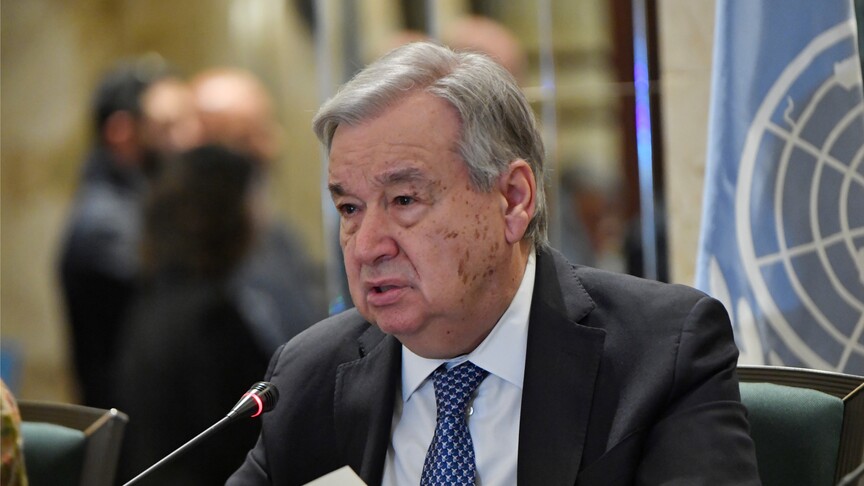
The UN Secretary-General's visit to Damascus on Friday restores high-level UN representation to Syria after a 17-year absence, in response to an official invitation, aiming to support the transitional phase and reaffirm sovereignty.
ISTANBUL: Laith al-Junaidi - Anadolu Agency
The visit comes after years of diplomatic estrangement between the UN and Syria due to the Syrian crisis.
The upcoming visit of UN Secretary-General António Guterres to the capital Damascus on Friday, according to local media, constitutes a pivotal diplomatic event in the course of relations between the international organization and Syria.
Guterres's visit is the first by a UN Secretary-General to Syria since 2009, when Ban Ki-moon visited.
Guterres's program includes holding official talks with Syrian President Ahmad al-Sharaa and Foreign Minister Asaad al-Shaibani, in addition to meetings with representatives of civil society and local community institutions.
The tour also includes a field visit to inspect the United Nations Disengagement Observer Force (UNDOF) stationed in the occupied Syrian Golan, following up on the commitments of the ceasefire agreement.
UN spokesman Stéphane Dujarric announced on Tuesday that Guterres would travel to Syria this week at the invitation of the government, and would meet President al-Sharaa and officials including al-Shaibani, without specifying the date of the visit.
** A Pivotal Shift
Guterres's visit represents a qualitative shift in the relationship between the UN and Syria, ending a 17-year hiatus.
This UN return to the heart of Syria is not seen as a mere protocol stop, but rather as the inauguration of a political and international decree that restores the Syrian state to the map of direct international interactions.
It also moves the Syrian file from crisis management through special envoys to the highest leadership levels of the international organization.
The first significance of this visit is manifest in granting UN support to the new transitional phase and a decisive affirmation of the pillars of Syrian sovereignty and territorial unity.
As for Guterres's upcoming meeting with the Syrian leadership represented by al-Sharaa and al-Shaibani, it carries a political message to regional and international powers affirming that the UN relies on official state institutions as a key partner in managing the political process, which contributes to accelerating the pace of lifting international diplomatic isolation from Damascus.
Ban Ki-moon was the last UN Secretary-General to visit Syria in 2009, which gives Guterres's upcoming visit political significance in light of the transitional phase the country has been witnessing since the fall of the former regime in December 2024.
** Highlighting the Golan File
On the field and security level, Guterres's tour to inspect the UN Disengagement Observer Force (UNDOF) in the occupied Syrian Golan acquires highly significant strategic dimensions.
Amid escalating regional tensions, the Secretary-General re-highlights the seriousness of the Golan file and the necessity of all parties' commitment to the armistice agreements and relevant UN resolutions, and the UN's adherence to its responsibilities in protecting international legitimacy decisions.
The Security Council established UNDOF on May 31, 1974, under Resolution 350, to monitor the ceasefire and oversee the implementation of the disengagement agreement between Syria and Israel.
The disengagement agreement, signed on the same day, stipulated the establishment of a buffer zone between Syrian and Israeli forces, and the designation of areas subject to restrictions on forces and armaments on both sides.
The agreement ended the state of combat and attrition on the Syrian front following the October 1973 war, and UNDOF has since been tasked with monitoring the ceasefire and implementing its provisions.
Following the fall of Bashar al-Assad's regime on December 8, 2024, Israeli Prime Minister Benjamin Netanyahu declared that the disengagement agreement had "collapsed" and ordered the army to occupy the buffer zone and other Syrian positions, including the Syrian side of Mount Hermon.
Since then, Israeli forces have carried out repeated incursions in southern Syria, while the UN continues to demand that Israel adhere to the 1974 agreement and respect Syria's sovereignty and territorial integrity.
** Building a Stable Future
On the humanitarian and economic track, the visit constitutes a fundamental turning point from the pattern of "emergency relief" to the broader scope based on "early recovery and reconstruction."
The Secretary-General's firsthand assessment of the comprehensive needs in Damascus paves the way to break the stalemate in international funding and urge donor countries to move toward sustainable development projects and infrastructure reconstruction, ensuring a conducive environment for the sustainable return of displaced persons and refugees.
On the domestic and societal level, Guterres's intensive meetings with civil society representatives and women's groups carry a profound significance regarding the UN vision for shaping Syria's future.
They reflect the international organization's commitment to the inclusiveness of the political process and the participation of all societal components in drafting the new constitution and managing the transitional phase to ensure long-term stability.
In this context, Dujarric indicated that Guterres would renew during the visit the UN's commitment to supporting Syria at this stage and affirm the need to respect its sovereignty, unity, independence, and territorial integrity.
The Secretary-General is expected to learn from Syrian officials about developments in the transitional phase, recovery efforts, and the effects of years of conflict, and will also meet representatives of civil society and non-governmental organizations concerned with women's issues and various components of Syrian society, according to the same source.
The visit gains symbolic importance in granting UN support to the new transitional phase. It also reaffirms the UN's commitment to Syria's sovereignty and territorial unity. It may open the door to broader international movements to support stability and reconstruction. The visit is expected to include discussions on political and humanitarian files.
Original source: Anadolu Agency
Comments (0)
Be the first to comment.