Japan says China conducted live-fire exercise in its exclusive economic zone
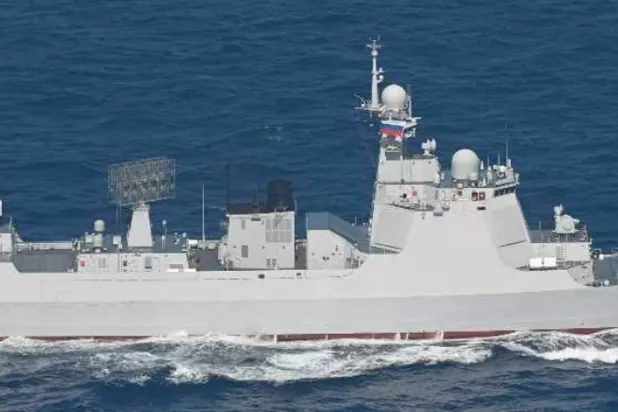
Japan's Defense Ministry said on Tuesday that a Chinese warship fired live ammunition in its exclusive economic zone during a joint exercise with Russia, which Beijing denied.
Japan's Defense Ministry said on Tuesday that a Chinese warship fired live ammunition in its exclusive economic zone during a joint exercise with Russia, which Beijing denied.
Local media reported that the maneuver took place on Sunday, and that it was the first time the ministry has detected and announced China conducting such an exercise in the area, according to Agence France-Presse.
Japanese government spokesman Minoru Kihara told reporters that Tokyo informed Beijing through diplomatic channels that the exercise "could have endangered ships in the vicinity."
The Defense Ministry spotted a Chinese destroyer capable of launching missiles maneuvering about 180 kilometers southwest of Okinotori Island, located in the southernmost part of Japanese territory.
At 2 a.m. on the same day, Tokyo had detected a fleet of three Chinese ships and a Russian frigate about 330 kilometers southwest of the island, heading northeast.
Japan's public broadcaster NHK reported that when the live-fire began, the Russian frigate was not far away.
Chinese Foreign Ministry spokesman Lin Jian said at a regular press conference on Tuesday that "the so-called concerns expressed by Japan are completely unfounded."
Under international law, an exclusive economic zone is defined as an area beyond territorial waters where the coastal state exercises sovereign rights for the purposes of exploring, exploiting, conserving, and managing resources. This zone extends up to 200 nautical miles (about 370 kilometers) from its shores.
Japan considers Okinotori an island, but Beijing insists it is merely rocks and says Tokyo cannot claim an exclusive economic zone around it under the United Nations Convention on the Law of the Sea.
Lin Jian said the maneuvers on Sunday, which took place "in international waters," were thus "in compliance with international law." He added: "Japan seeks to distort and exaggerate the legitimate actions of other countries, and plays the external threat card to justify its accelerating rearmament."
The exercise prompted Tokyo to deploy its ships and aircraft for monitoring, according to Japanese government spokesman, adding: "We will continue to monitor the movements of Chinese and Russian ships with concern in the waters around our country."
In early July, Japanese and Chinese coast guard vessels confronted each other near disputed islands, with each side accusing the other of violating its territorial waters.
Relations between Beijing and Tokyo have been tense since Japanese Prime Minister Sanae Takaichi hinted in November that her country might intervene militarily if China attacked Taiwan Island.
China condemned the stance and has since urged its citizens to avoid traveling to Japan and tightened trade restrictions on some Japanese companies.
Original source: Asharq Al-Awsat

Comments (0)
Be the first to comment.