Lebanese President Links Disarming Hezbollah to Three Conditions
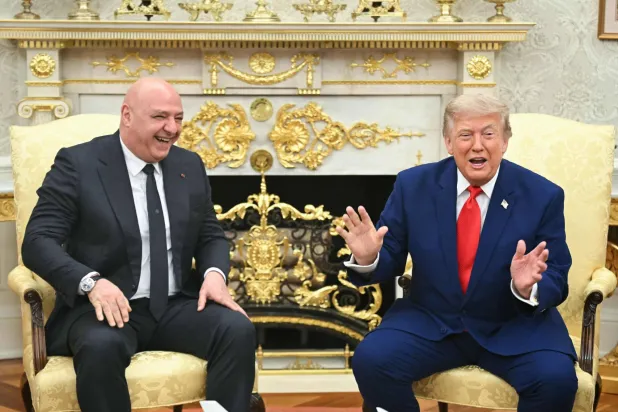
From Washington, Lebanese President Joseph Aoun has reframed the debate over the exclusivity of state arms, linking the achievement of this goal for the first time to three interdependent conditions aimed at ending the pretexts for carrying weapons: ending the Israeli occupation, extending the state's authority through the Lebanese army over all territories, and launching a state-led reconstruction initiative.
While supporters of this approach view it as establishing an integrated roadmap for restoring the state, the Hezbollah and Amal Movement duo preferred to take a wait-and-see attitude, considering that judgment on the outcomes of the Washington visit should be based on practical results on the ground rather than speeches and political positions.
In parallel, Information Minister Paul Morcos stated that "American support for Lebanon takes multiple forms, including consolidating, sustaining, and expanding military support for the Lebanese army, alongside mobilizing international support and encouraging friendly countries to invest and provide aid," noting the possibility of the United States directly engaging in a conference to support Lebanon.
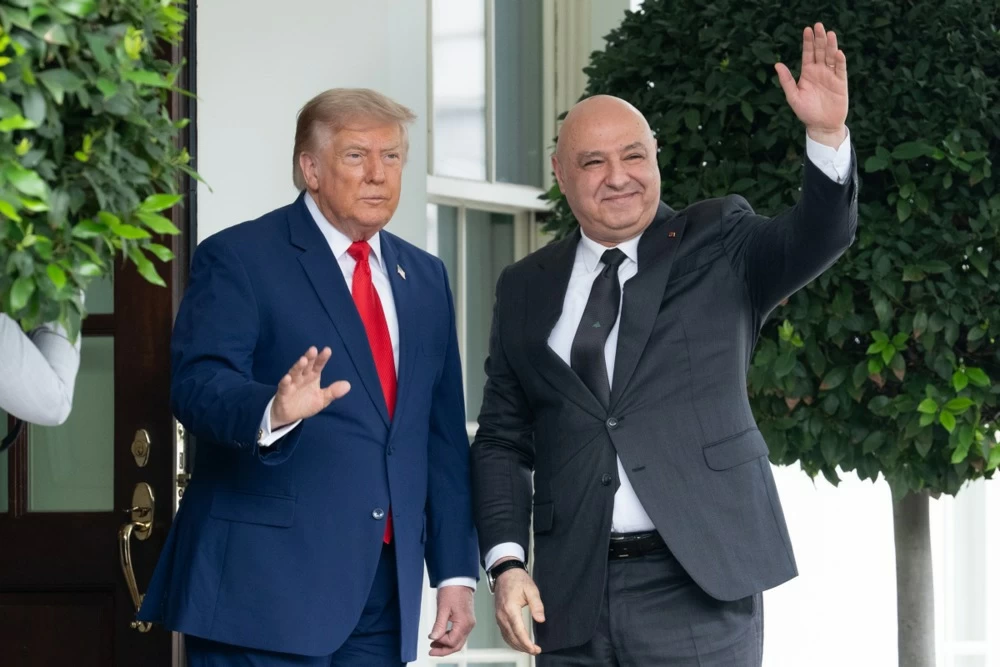
Morcos emphasized that the President of the Republic "settled this file when he explicitly announced, during his meeting with US President Donald Trump, his full confidence in the Lebanese army, its leadership, and its personnel," pointing out that US military support for the army is "poised to continue and be enhanced" following the visit.
He stressed that President Aoun adheres to "the complete withdrawal of Israeli occupation forces from Lebanese territory," considering that "speeding up the pace of these steps and building upon the positive results achieved will strengthen existing arrangements and achieve the desired national goal, within the framework of the presidential initiative that has begun to bear fruit."
From Disarmament to the Conditions for Statehood
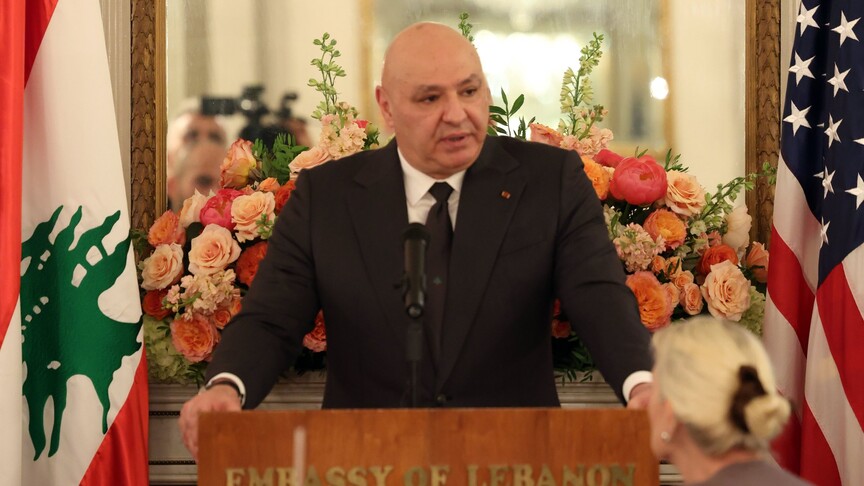
In his speech before the Lebanese diaspora in Washington, the President of the Republic shifted the debate from the question of "How are weapons disarmed?" to a more comprehensive question regarding how to provide the political, security, and economic conditions that make the exclusivity of arms a natural consequence of statehood, rather than merely a security decision.
Elias Hankash, a member of the Kataeb Party bloc, opined that the President of the Republic has not only raised the ceiling of negotiations but has also reshaped Lebanon's position at the negotiating table. Hankash told Asharq Al-Awsat that President Joseph Aoun "has drawn up an integrated roadmap based on Israeli withdrawal, the exclusivity of arms, reconstruction, strengthening the army, and restoring state sovereignty over all its territories."
A Lebanese army soldier inside a military vehicle in the southern Lebanese town of Zawtar al-Gharbiya following the army's deployment in the area after the withdrawal of Israeli forces (Reuters)
He explained that "President Aoun is negotiating today from the standpoint of the state, institutions, and Lebanese political decision-making, contrary to all attempts by Iran or Hezbollah to portray the Lebanese position as an extension of their choices."
He added: "Lebanon practically entered the negotiating table from a losing position, after Hezbollah dragged the war into the Lebanese interior and unilaterally took the adventure-driven decision that led to destruction, occupation, and heavy costs for the country."
Hankash considered that "the natural course of wars usually forces the losing party to comply with the victor's conditions," but pointed out that the President of the Republic, "thanks to his personality, position, popular rallying around him, and international interest in Lebanon, has managed to alter this reality, improve the terms of negotiation, and put forward a political formula that preserves Lebanon's interests."
He said: "President Aoun was able to impose a clear roadmap and transform the three files—namely Israeli withdrawal, the exclusivity of arms, and reconstruction—into an interconnected path whose main title is the establishment of the state and the assertion of its sovereignty."
Hankash stressed that "the weapons file cannot be addressed outside the framework of strengthening the Lebanese army and empowering it," considering that "the Israeli withdrawal gives the state an additional political and national justification to end all pretexts used domestically to keep weapons outside the law."
He added: "The state can address the weapons file, but Israel's withdrawal constitutes clear proof that political negotiations and international pressure—not Hezbollah, Iran, missiles, or the military arsenal—are what achieve withdrawal and protect Lebanon's interests."
Hankash noted that including the reconstruction file within this roadmap "is not a separate issue from restoring the state," pointing out that "the scene that unfolded in Zawtar, coinciding with the Prime Minister's presence and the deployment of the army, provided evidence that the return of the state and its sovereignty paves the way for the return of residents, reconstruction, and the consolidation of stability."
Smoke rises from the southern Lebanese town of Kafr Tibnit following an explosion carried out by the Israeli army (AFP)
The "Duo": Too Early to Draw Conclusions
In contrast, the "Shiite Duo" has so far refused to treat the President's speech as the announcement of a new political formula, preferring to await the outcome of the next phase.
A source close to the Hezbollah and Amal duo told Asharq Al-Awsat that "what has been proposed so far still requires careful reading," and that "it is premature to draw final conclusions as to whether the president has drawn a new formula linking the exclusivity of arms to Israeli withdrawal and reconstruction."
The source continued: "The Israeli occupation remains the main reason for the continued existence of the resistance, and therefore ending the occupation constitutes the natural gateway to addressing this file, but it cannot be said that President Aoun has announced a clear formula based on a mutual exchange of steps."
The "Socialist" Party Links Withdrawal to Disarmament
In a stance reflecting the approach of the Progressive Socialist Party, the secretary of the Democratic Gathering, MP Hadi Abu Al-Hassan, told Asharq Al-Awsat: "We highly appreciate the advanced position of President Joseph Aoun, expressed from Washington, which reflects his keenness and patriotism in pushing toward a peaceful solution path based on exerting sufficient pressure to force Israel to completely withdraw from Lebanese territory, in parallel with confining arms to the Lebanese state, leading to the implementation of Resolution 1701 and the Taif Agreement."
He added: "This is the same position expressed by both President Walid Jumblatt and party leader MP Taymour Jumblatt. It also takes us back to a previous stage, when Jumblatt drew a roadmap for a solution based on removing the causes of war, foremost among which is the Israeli occupation, and considering that Hezbollah, despite its ideological bond with the Islamic Republic of Iran, remains a Lebanese component, and that addressing this file is not done by force, but through internal dialogue, starting from the spirit of the ministerial statement, government decisions, and the implementation of international resolutions, particularly Resolution 1701 and the Taif Agreement."
Original source: Asharq Al-Awsat


Comments (0)
Be the first to comment.