Lebanese President: My Meeting with Trump Was Fruitful and Time to End War
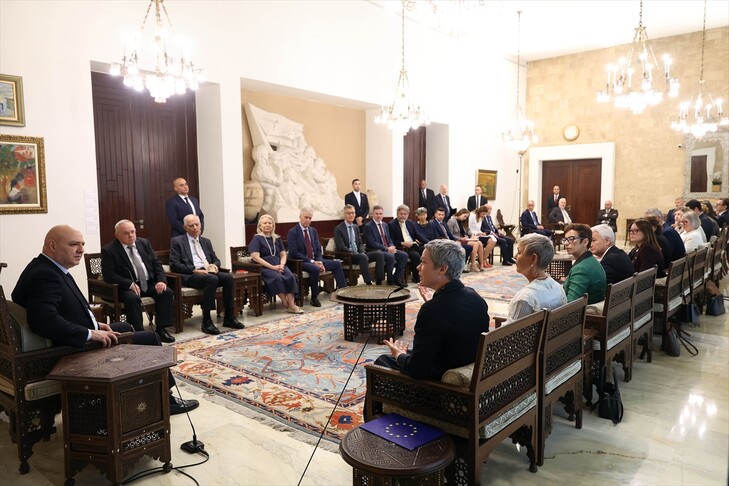
Lebanese President Joseph Aoun called on the European Union to support the implementation of the "framework agreement", considering that ending the war opens the way for economic growth and attracting investments..
Anadolu Agency correspondent Waseem Saif al-Din reported from Beirut.
The Lebanese president's remarks come at a time when the region is witnessing intensive diplomatic efforts to reach a ceasefire on the Lebanese-Israeli border.
Lebanese President Joseph Aoun said Friday that the time has come to completely end the war, considering that his meeting with his US counterpart Donald Trump in Washington was fruitful and paves the way for economic growth and attracting investments to Lebanon.
This came during his reception of European Union Ambassador to Lebanon Sandra De Waele, accompanied by a number of ambassadors from European and Western countries, at the Presidential Palace east of Beirut, according to a presidential statement.
Aoun said that his discussions with Trump focused on implementing the framework agreement signed between Lebanon and Israel under US auspices, and completing the Israeli withdrawal and deploying the Lebanese army in the areas from which Israeli forces withdraw.
He called on the European Union to support the implementation of the "framework agreement" and prevent obstruction of its application, considering it the way to achieve peace and stability in southern Lebanon, stressing that his country is committed to implementing the agreement's provisions, especially those related to security and reconstruction.
Aoun considered that the presence of the United Nations Interim Force in Lebanon (UNIFIL) remains the best option for the next phase, calling for the formation of an alternative force if its continuation is not possible, to help the Lebanese army in clearing mines and unexploded ordnance from the south and accompany the implementation of the framework agreement.
The "framework agreement," reached during Lebanese-American-Israeli negotiations, stipulates the completion of the Israeli withdrawal from Lebanese territory in exchange for the deployment of the Lebanese army in border areas.
Aoun added that ending the war will open the door to focusing on economic, financial, banking, and judicial files, stressing that security and political stability are a prerequisite for the success of any economic path.
The Lebanese president affirmed his country's commitment to continuing reforms, especially economic ones, as a "domestic Lebanese need," noting that the war hindered the implementation of several steps, but the state continues to work to restore confidence in the banking sector and achieve financial regularity.
He also stressed that Lebanon's stability is reflected in the stability of the region, calling for continued European support, especially in the areas of judicial reform and anti-corruption.
For her part, EU Ambassador Sandra De Waele said that Lebanon stands at a "crossroads and the beginning of a new chapter," affirming the European Union's support for the path of security, stability, and reforms, and the importance of reaching an agreement with the International Monetary Fund to restore investor confidence.
Photo: Lebanese Presidency/Handout/AA
In a related context, Aoun discussed with Prime Minister Nawaf Salam the results of his visit to the United States, and briefed him on the outcomes of his meetings with Trump and Secretary of State Marco Rubio, and the readiness expressed by US officials to support the Lebanese army and assist Lebanon in various fields, according to another presidential statement.
The statement added that Aoun presented Washington's commitment to work on implementing the "framework agreement," amid Lebanon's insistence on completing the Israeli withdrawal from southern villages and towns up to the border.
On Wednesday, Aoun returned from the United States after a four-day working visit, during which he met with Trump and Rubio.
For his part, Salam briefed the Lebanese president on the results of his visit to the town of Zawtar al-Gharbiyeh following the Israeli withdrawal from it, stressing the state's determination to secure the needs of southern residents to ensure their staying on their land and the continuity of their livelihoods.
This coincided with the start of the return of the residents of Zawtar al-Gharbiyeh to their town, after the Lebanese army engineering teams completed the removal of suspicious obstacles, unexploded bombs, and mines left by the Israeli army.
In a separate meeting, Aoun discussed with Defense Minister Michel Menassa the army's measures to enhance its deployment in southern towns and villages, especially Zawtar al-Gharbiyeh, following the withdrawal of Israeli forces, in addition to the status of the military institution and the needs of military personnel.
Zawtar al-Gharbiyeh, located south of the Litani River, is one of the pilot areas covered by the first phase of the agreement signed on June 26 last year.
The agreement stipulates a gradual Israeli withdrawal from occupied Lebanese territory, starting with a model implementation in pilot areas, with the Lebanese army assuming security responsibility in the areas from which Israeli forces withdraw, alongside disarming armed groups, in reference to "Hezbollah."
On Monday, the US State Department announced the start of the implementation of the pilot zone in the towns of Faroun, Sirif, and Zawtar al-Gharbiyeh, according to the tripartite framework and under the auspices of the Military Coordination Group for Lebanon.
Since March 2, 2026, Israel has continued its aggression on Lebanon, resulting in the deaths of 4,329 people and injuries to 12,233 others, according to the Lebanese Ministry of Health.
Israel occupies areas in southern Lebanon, some for decades, and others since the confrontations that took place in the region between 2023 and 2024, and it has advanced more than 10 kilometers into Lebanese territory during the current aggression.
The framework agreement, reached through tripartite negotiations, stipulates a full Israeli withdrawal from Lebanese territory in exchange for the deployment of the Lebanese army. Analysts believe that Lebanon's stability is linked to ending the war that hindered economic reforms. Aoun affirmed his country's commitment to reforms, stressing that security stability is a prerequisite for economic recovery. He also noted that European Union support is necessary to complete judicial reform and combat corruption.
Original source: Anadolu Agency


Comments (0)
Be the first to comment.