New Libyan Government 'Made in Geneva' Widens Division
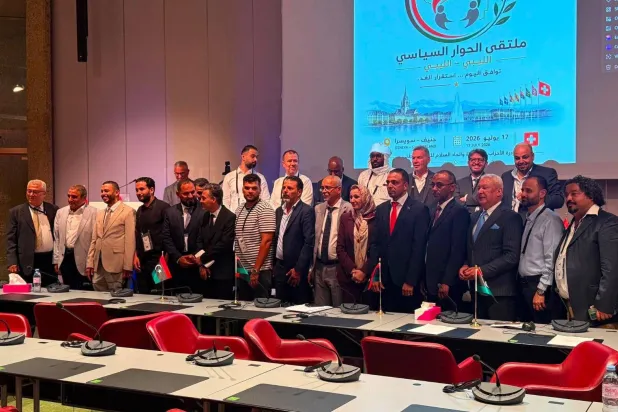
أعلنت مجموعة من النشطاء والسياسيين الليبيين في جنيف تشكيل حكومة موحدة، في خطوة فاجأت الأوساط السياسية وأثارت تساؤلات حول شرعيتها، خاصة مع تزامنها مع حراك دولي لإنهاء المرحلة الانتقالية.
The organizers of the Geneva initiative raised the slogan of 'Libyan-Libyan dialogue' away from external guardianship, but the announcement of a new government opened the door to questions about its legitimacy, timing, and ability to transform from a political initiative into a feasible reality.
At a time when Libyan political circles were awaiting the outcome of an initiative being shaped by the United States to unify executive and security institutions and end the transitional period, a group of activists and politicians surprised the scene by announcing the formation of a 'unified Libyan government' from the Swiss city of Geneva, a move that shifted the debate from waiting for an anticipated international initiative to a wide controversy over a local initiative that, in the eyes of many, appeared to be a preemptive attempt to impose a new political reality, and even to preempt any arrangements being prepared behind the scenes.
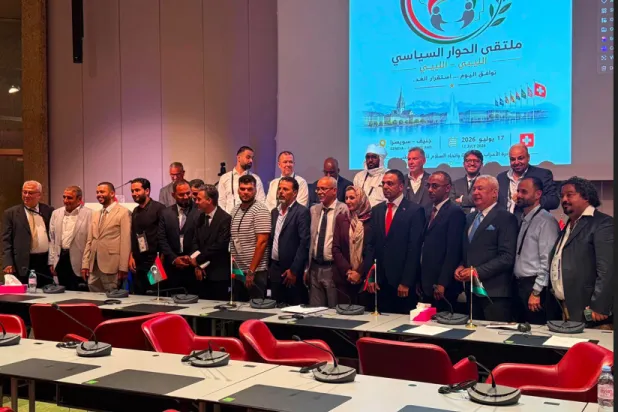
From the heart of the Swiss city, whose name has been linked to Libyan dialogue milestones in recent years, the participants in what they called the 'Libyan Political Dialogue Forum' emerged to announce the assignment of Mustafa al-Majdoub to head a new government, stressing that their project stems from a pure Libyan will, away from United Nations sponsorship or any external guardianship.
A Spiral of Controversy
The announcement of the new government came as a great and surprising shock to the political establishment, starting with the name of the prime minister himself, who is not known for any prominent political roles at the national level and has never held any known executive or legislative positions, raising questions about the criteria for his selection to head the government announced from Geneva.
As for the announcement itself, which initially seemed an attempt to break the political deadlock, it quickly sparked a wide wave of questions about its causes and repercussions: Does this step represent the beginning of a new political path reflecting discontent with existing institutions, or is it just another headline added to the list of initiatives that never materialized? Did it come in response to a real political vacuum, or does it reflect a frantic race to impose new facts before any international settlement of the Libyan crisis takes shape?
Read more
Libyan cultural life revives with the Arab 'Season' Festival
Carcinogenic agricultural pesticides alarm Libyan health authorities
Dismissal of Libyan intelligence chief opens door to disputes
In the Libyan issue... intelligence advances and diplomacy fades
Anticipating these questions and expected criticism, the organizing group of the dialogue said in a statement that 'its project is based on a preparatory committee comprising 60 figures distributed equally among the three historical regions, representing parties, civil society organizations, and women's figures, with the aim of formulating a political project led by Libyans themselves away from external interference.'
It was clear in the statement that the initiative targets not only the Libyan interior but also carries a message to the international community that there are Libyan parties that reject the continued management of the file through external initiatives. This was indicated in a statement by Abdulhakim Bayou, one of the candidates for prime minister of the new government, who stressed that the participants came to Geneva to say that Libya is 'not a file to be shared among countries' and that the national decision must remain in the hands of Libyans alone.
Bayou also called for the withdrawal of all foreign forces and mercenary groups, whether Russian or Turkish, within a period not exceeding two months, while at the same time emphasizing economic openness to all countries and welcoming Turkish and Russian companies to contribute to reconstruction in accordance with Libyan laws.
Bayou explicitly announced his rejection of the initiative of US President's senior advisor Massad Boulos, considering that 'any path that bypasses the national will will not gain acceptance,' while welcoming the tripartite agreement between the House of Representatives, the High Council of State, and the Presidential Council as a step that can be built upon to reach elections.
Why Now?
Despite attempts to present the initiative as a comprehensive national project, its timing raised many question marks, especially as it coincides with increasing international political activity led by the United States and several regional parties to find a new formula to end the transitional period.
Libyan journalist Fateh Al-Khashmi suggested that 'the choice of timing for the announcement was not spontaneous, but came amid a growing feeling among some political and civil forces that the scene is heading towards new power-sharing arrangements among specific parties cooked up outside the Libyan will, which prompted this group to try to present itself as a national alternative that rejects the reproduction of international guardianship.'
The initiative also reflects, on another level, according to Al-Khashmi, 'the extent of frustration that dominates sectors of the Libyan elite after years of stalled UN tracks and successive transitional governments without reaching elections to end the state of division.'
He added, 'But this motive, however valid, does not necessarily mean that the initiative possesses the necessary ingredients to turn into a viable political project, especially given the lack of recognition by official institutions and active military forces.'
As for political researcher Abdelaziz Aghniya, he summarized his stance on the initiative by saying that what happened is reminiscent of the experience of Khalifa al-Ghawil's government, considering it nothing but a new political maneuvering by parties that participated in draining the country.
Political analyst Ahmed Al-Mahdawi goes further in his description, considering that what is happening in Geneva is a 'meager political play' that reproduces the same faces and the same mechanisms that led Libya to division.
Al-Mahdawi believes that 'reducing the Libyan crisis to closed meetings to choose a prime minister away from popular will and legitimate institutions will not produce a solution, but will rather add a new layer of loss of trust, stressing that Libya does not need governments made in hotels and meeting halls as much as it needs institutions that derive their legitimacy from the ballot box.'
Changing the Rules of the Game
In contrast, political analyst Fawzi Najm warned against underestimating political moves of this kind, saying: 'From a practical standpoint, the chances of the government announced in Geneva turning into an effective executive authority seem limited, given the lack of local and international recognition and its lack of implementation tools or field influence, but that does not mean the step is without impact.'
He continued: 'The mere announcement of a new government reflects the extent of restlessness within the Libyan scene, and confirms that the state of political deadlock is pushing various groups to search for alternative paths outside the traditional frameworks led by the United Nations in recent years. The initiative may further complicate the scene if it turns into a platform that attracts new personalities or political forces, adding another actor to an already crowded map of competing bodies and institutions.'
He explained: 'The Geneva initiative reveals, above all, the widening gap between the aspirations of sectors of Libyans to regain the national decision and a political reality still governed by complex internal and external balances. It carries slogans that resonate with part of public opinion, such as rejecting foreign guardianship, demanding the withdrawal of foreign forces, and ending the transitional period through elections, but at the same time it collides with a fundamental question: Who has sufficient legitimacy to turn these slogans into institutions and recognized authority?'
Original source: Independent Arabia

Comments (0)
Be the first to comment.