Remnants of al-Assad and Hezbollah... Lebanon no longer safe, return to Syria 'an option on the table'
Individuals and officers from al-Assad's regime and Syrian Hezbollah members who fled to Lebanon after its fall have begun seeking more stable alternatives, while others find returning to Syria a viable option.
Driven by fears and a pessimistic view of the evolving military and political situation, individuals and officers from al-Assad's regime and Syrian Hezbollah members who fled to Lebanon after the fall of the regime have begun seeking more stable alternatives, while others find returning to Syria 'an option on the table'.
'We go to sleep on the narrative of Syrian military intervention, and wake up to the possibility of rapprochement between Hezbollah and the Syrian state. Whatever the option, we are the losing party,' with these words Hadi, a former Hezbollah security operative from the northern countryside of Homs, describes the situation of Syrians associated with the party in Lebanon.
The friendly discourse and its evolution in Syrian-Lebanese relations, along with the ambiguity of the Syrian administration's and Hezbollah leadership's directions, raise fears among this group of a rapprochement between the two sides, amid increasing talk of the possibility of lifting protection from them and restricting their security activities.
Syrian army patrols along the Syrian-Lebanese border in the Qusayr countryside, April 2026, and combing tunnels used by Hezbollah (AFP)
The Syrian segment protected by Hezbollah in Lebanon, especially the poor, fears turning into a 'card for rapprochement or negotiation' with Damascus, as many of this group find themselves driven to seek safe return paths to Syria or to flee to other countries, amid declining interest in them and worsening harsh living conditions.
This is what Hadi began, noting that 'the majority of Syrians feel a decline in the intensity of the hostile tone towards the new Syrian state, and what was a red line in approving any stance towards al-Jolani's government has become normal today as long as it does not touch the sect.'
Hadi asked his relatives in Syria to inquire about his security status, and whether there are arrest warrants and legal cases against him that could lead to his arrest if he returns, due to his work with the party from 2013 until the fall of Bashar's regime.
What deepened the fears of this group was the recent media appearance of Hezbollah leader Naim Qassem, who praised 'the Syrian leadership's decision to refuse participation in a pincer movement with Israel through military intervention in Lebanon.'
This came after Syrian President Ahmad al-Shara renewed his stance rejecting intervention against Hezbollah and supporting the language of dialogue, as Foreign Minister Asaad al-Shibani affirmed during his visit to Beirut at the beginning of this July the possibility of sitting with the party 'if interest dictates.'
Hezbollah flags in the city of Qusayr on the Syrian-Lebanese border, June 2013 (AFP)
As for Abdel Razzaq, who joined the security section of Hezbollah in the Sayyida Zainab area in the Damascus countryside, he has already taken his step by returning his family to Syria with the start of the Israeli war on Lebanon, while his stance remains hesitant 'waiting for the green light to join them, or to travel to another country.'
Abdel Razzaq believes that if one's record is clean, 'returning to Syria today is much better than living in poverty and constant fear of being handed over to the Lebanese state on the pretext of our illegal presence, which means deportation and trial in Syria,' noting that 'many have reconciled and returned to their normal lives.'
Whatever the outcome, according to Abdel Razzaq, 'whether understanding, war, or the entry of Syrian forces as rumored, we will be the scapegoat, especially since most of us live here without official documents from any UN or governmental body.'
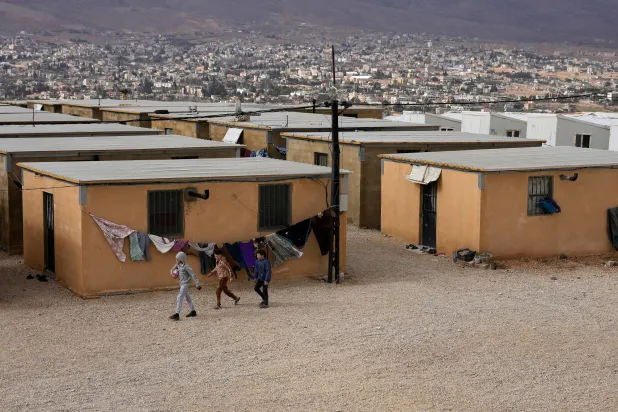
Syrian refugee in a camp set up by Hezbollah in Hermel, eastern Lebanon (EPA)
Home is Safer
For her part, Zeinab, from the town of Zahraa in the Aleppo countryside, refused to wait for her husband to obtain reassurances, forcing him to return immediately after the start of the Israeli war in Lebanon, due to the difficult living conditions they faced in the southern suburb, pointing to the safe situation in Aleppo and the absence of retaliatory acts.
Zeinab's husband was a military engineer officer in clearing war remnants, 'with no relation to fighting or military operations,' according to her, 'after it was proven that he did not participate in fighting with Bashar's army, he reconciled his status in Aleppo without facing any abuse.'
Zeinab told Asharq Al-Awsat that she repeatedly inquired about the security situation of a number of her relatives and acquaintances in Lebanon, including her father, who worked as a cleaner at one of Hezbollah's headquarters in Sayyida Zainab and fled after the fall of the regime for fear of retribution.
Arrest of a member of Hezbollah cells in the Sayyida Zainab area near Damascus (Syrian Interior Ministry)
No Collective Revenge
Sources in the Syrian Interior Ministry confirmed to Asharq Al-Awsat that the Syrian state rejects the policy of collective revenge, as 'the repercussions of the war the country experienced cannot be ended by holding children and women accountable for the crimes committed by adults.'
However, it pointed out that elements who were in the security or military apparatus of the regime need to reconcile their status upon entering the country, noting that 'whoever is proven to have harmed anyone, participated in acts that caused harm to civilians, or is wanted for personal claims such as property grabbing, theft, etc., will be arrested.' Adding that 'the presented status reconciliation does not negate or protect the person from subsequent personal claims such as proven involvement in crimes against civilians.'
Elements of the National Defense Forces parallel to al-Assad's forces, one carrying the flag of the Syrian Social Nationalist Party in Maaloula town northeast of Damascus, June 13, 2015 (AFP)
Assad's Legacy
Diaa, a former political security officer, ruled out that Hezbollah would hand him and other elements over to the Syrian government, but the party may resort to other methods driven by the state of unease in its support areas crowded with Syrians, according to him.
This includes, Diaa says, 'increasing restrictions, which is already happening, whether through reducing food aid or imposing surveillance on our movements as former officers who were not in the party's ranks, or it may lift its protection from us, making us easy targets for security campaigns.'
According to Diaa, many regime remnants 'still dream of regaining power and are active in border areas with Syria, a protected group because it is useful to the party.'
As for the majority of fugitives, especially breadwinners, they have been shocked by the reality of life in Lebanon, so they try to find ways for safe return or asylum to other countries. Diaa, like many, is waiting for a departure visa to an Arab country, while others await a response from UN organizations to their applications for immigration to European countries, Australia, and New Zealand, as the safest and most stable destinations.
Security expert Brigadier General Imad Shuhoud agrees with the idea that Hezbollah does not trust elements of the fallen regime, even during its presence in Syrian territory, as 'it did not consider the militias and army of Bashar al-Assad as friendly forces, something revealed by its security and military working mechanism there.'
Nevertheless, Brigadier General Imad Shuhoud rules out the party giving up the Syrian fighting elements, considering them a pressure card against the Syrian government in the long run, and a huge reserve force of over 10,000 fighters living today in special camps, such as Khamenei Camp, the majority of whom oppose the new Syrian authority for doctrinal and ideological reasons, making them the first line of defense and a source of chaos to destabilize Damascus.
"); googletag.cmd.push(function() { onDvtagReady(function () { googletag.display('div-gpt-ad-3341368-4'); }); }); }
Original source: Asharq Al-Awsat




Comments (0)
Be the first to comment.