Aoun's Visit to Washington: What Does He Want from Trump? And Was the Reception 'Lackluster'?
The limited reception for Lebanese President Joseph Aoun in Washington sparked debate about the level of the visit, with some calling it an 'insult' and others viewing it as standard for working visits. What does the American protocol stipulate, and what are the key files and bets Aoun carries to his meeting with President Donald Trump?
Aoun's Visit to Washington: What Does He Want from Trump? And Was the Reception 'Lackluster'?
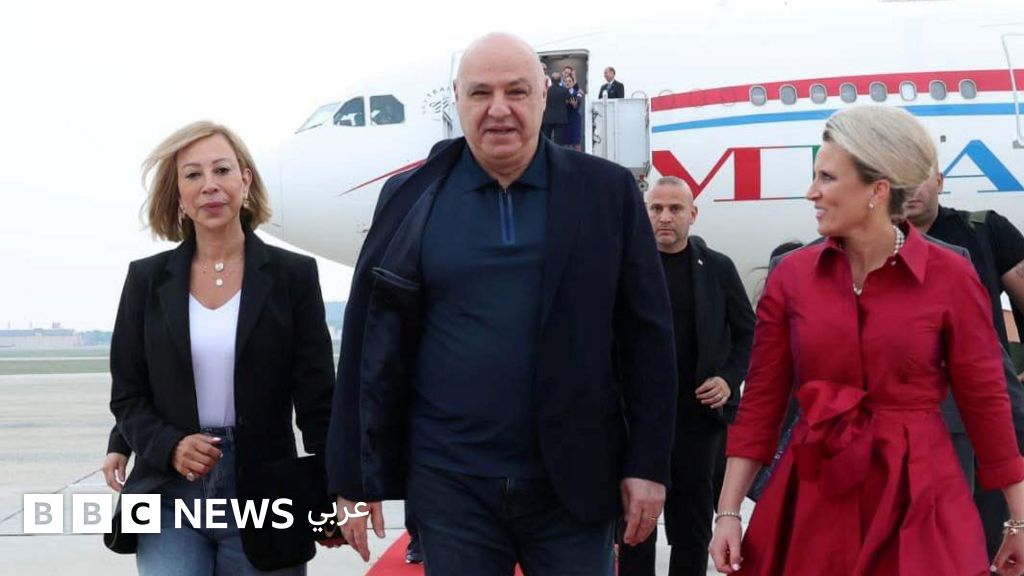
Image caption, Lebanese President Joseph Aoun and his wife Nimat arrived at Andrews Air Force Base near Washington on Saturday.
Article Information
Author, Ahmed AbdullahRole, BBC News Arabic - Beirut
Published 4 hours ago
Reading time: 6 minutes
As Lebanese President Joseph Aoun arrived in Washington carrying files on Israeli withdrawal from southern Lebanon, Hezbollah's weapons, army support, and reconstruction, the first minutes of his arrival became fodder for political and media debate in Lebanon.
Critics considered that the reception Aoun received on Saturday at Andrews Air Force Base was not commensurate with a visit by a head of state to Washington for the first time in nearly 17 years, while others saw that what happened did not deviate from the rules of a visit dominated by work and negotiations, not a 'state visit' with its accompanying ceremonies and celebrations.
But what happened upon the Lebanese president's arrival? Was he actually subjected to a protocol snub? And what files is he supposed to discuss with US President Donald Trump?
Sources in the Lebanese presidency to BBC: 'A meeting between Aoun and Netanyahu is completely rejected'
Lebanon-Israel talks in Rome: Why did they move from Washington? And what are their key files?
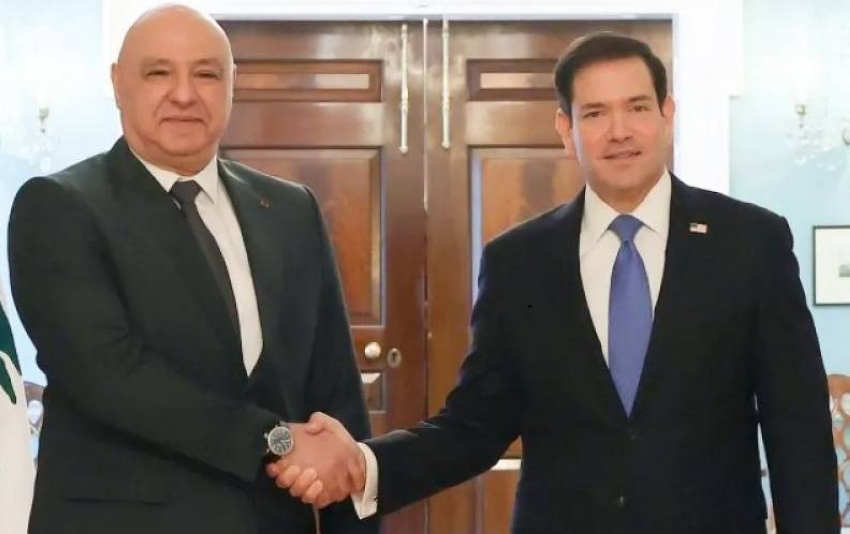
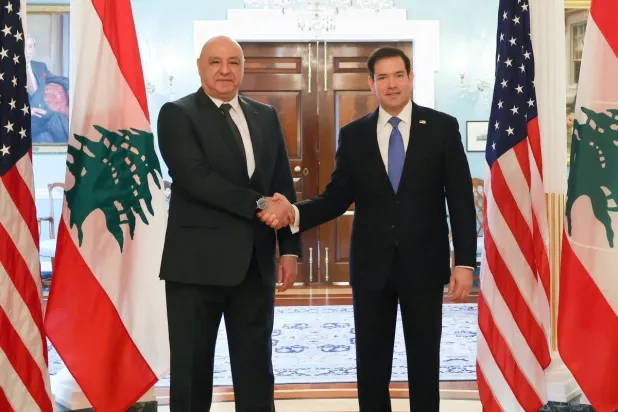
Image caption, Aoun during his meeting with Rubio demanded the first Israeli withdrawal from the 'first model zone'.
Who received Aoun at the airport?
Aoun and his wife Nimat arrived on Saturday at Andrews Military Air Base near Washington, on a visit that the Lebanese presidency said came in response to an invitation from Trump.
Widely circulated footage showed a limited reception on the base tarmac, without the presence of a US minister or senior political official, prompting Lebanese accounts and websites to talk about an 'absence of official US reception' or describe the scene as a 'modest' and 'lackluster' reception.
According to the Lebanese presidency, those who received Aoun included the Director of Protocol at the US State Department, the commander of Andrews Base, along with Lebanon's ambassador to Washington Nada Hamadeh Moawad, Lebanon's Permanent Representative to the United Nations Ahmed Arafa, and a number of Lebanese diplomats.
Criticism was further fueled by the lack of announcement of a joint press appearance after Aoun's meeting with US Secretary of State Marco Rubio on Sunday, and the State Department's reliance on a brief statement about the talks, while the Lebanese presidency and the US secretary of state published photos from the meeting.
A breach of US protocol?
Image caption, Bush's reception of the Pope at the airport was the first of its kind by a US president since 1959.
The limited reception of the Lebanese president at Andrews Base raised questions in Lebanon about whether it reflected a diminution of the visit's status. But available information does not indicate a clear breach of US protocol.
Skip the most read and continue reading
The other World Cup winner... Lamine Yamal's little brother who captivated the internet
Trump threatens Iran with a 'much bigger' price after killing of American soldiers, and Tehran says it is in a 'comprehensive war' with Washington
Trump's parade a perfect end to a lavish World Cup - The Guardian
'Access to the Red Sea': A new chapter in the Egypt-Ethiopia conflict
Skip the podcast and continue reading
Worth paying attention
In-depth explanation of major events and topics, to help you understand the most important changes around you and their impact on your life
Episodes
End of podcast
The United States does not adopt uniform ceremonies for all visiting leaders; rather, the level of reception varies according to the classification of the visit and its pre-agreed program.
A 'state visit' is the highest level of visits and typically includes a reception ceremony at the White House, a 21-gun salute, a review of the honor guard, and a state dinner. Working visits, on the other hand, focus on political talks and may occur without extensive ceremonies, dinner, or joint press conference.
The absence of the US president or a senior administration official from receiving Aoun at the airport does not in itself constitute a protocol violation. The official record of Andrews Base indicates that President George Bush's going to the airport to receive Pope Benedict XVI in 2008 was the first such reception by a US president since 1959, indicating that a president receiving guests at the airport is an exception, not the rule.
The US State Department previously classified former Lebanese President Michel Suleiman's visit to the White House in December 2009 as a 'working visit', despite his meeting with President Barack Obama.
Thus, it can be said that Aoun's reception was notably limited in ceremonial terms, but the arrival scene alone is insufficient to prove an insult or protocol violation. The importance of the visit may become clearer through the White House reception, the nature of Aoun's upcoming meeting on Tuesday with President Donald Trump, and the political results that will emerge from it.
What is Aoun carrying to Washington?
The visit comes less than a month after the signing of the 'Triple Work Framework' between Lebanon, Israel, and the United States on June 26, and after the conclusion of a sixth round of Lebanese-Israeli talks in Rome.
The framework stipulates the establishment of 'model zones' in southern Lebanon, where the Lebanese state and army will remove weapons of armed groups and their military structures, before verification by a party agreed upon by the sides, in parallel with army deployment and gradual Israeli withdrawal.
The United States said after the Rome talks that the two sides agreed on the structure and guidelines for the model zones, with technical details to be completed and implementation to begin. But Israel has not yet carried out the withdrawal demanded by Lebanon from the first of these zones, amid disagreement over the order and conditions of steps. Israel says its forces will remain as long as Hezbollah is armed, while Lebanon demands withdrawal in parallel with army deployment, according to Reuters.
According to the Lebanese presidency, Aoun during his meeting with Rubio demanded the first Israeli withdrawal from the 'first model zone', and enhanced US support for the army and military institutions, along with opening the door for economic and investment cooperation.
The presidency also said that Aoun seeks to solidify the ceasefire, Israeli withdrawal from Lebanese territory, and the extension of state authority over the entire country.
Reuters quoted a Lebanese official as saying that Aoun will present to Trump a written proposal to address Hezbollah's arsenal, and that the Lebanese president believes Trump has the necessary leverage to pressure Israel for withdrawal and help Lebanon regain its sovereignty.
What does Washington want from Lebanon?
A difference in priorities appears between the Lebanese and American statements after the Aoun-Rubio meeting.
The Lebanese statement focused on the necessity of beginning Israeli withdrawal, while the State Department said Rubio praised the efforts of Aoun's government to 'restore Lebanon's sovereignty, disarm Hezbollah, dismantle its terrorist structure, and move toward peace'.
Rubio renewed Washington's commitment to implementing the Triple Work Framework and supporting the Lebanese government to achieve peace and economic recovery, but he did not explicitly refer in his public statement to a timeline for Israeli withdrawal or to applying pressure on Israel, according to the State Department.
Original source: BBC Arabic

Comments (0)
Be the first to comment.