Under Trump: How World Trust in Washington Eroded
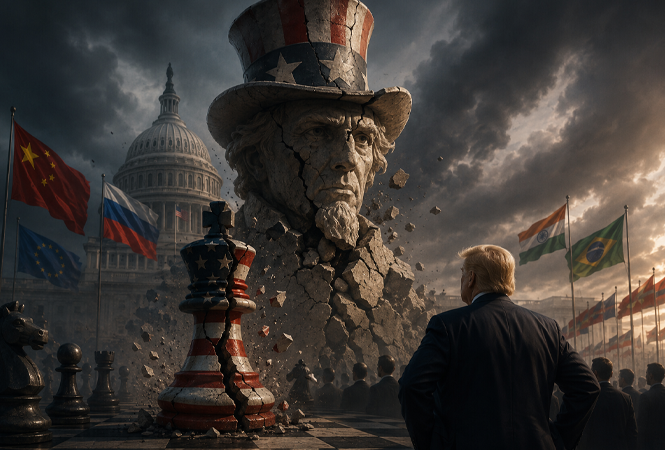
Under Trump: How World Trust in Washington Eroded
For decades, the United States relied not only on its military and economic power, but on a less visible and more influential element: trust.
A single statement from the president could move markets, reshape allies' calculations, and push adversaries to reassess their positions. But under Donald Trump, this equation began to change gradually. With repeated contradictory statements, erratic policies, and reliance on threats as a negotiating tool, the question is no longer about what Washington will do, but whether the world still believes it.
American Statements
Since his first term, President Donald Trump has insisted that the United States enjoys unprecedented respect. However, his second term arrived amid growing signs of declining trust in American leadership.
During the early months of his term, the administration routinely issued statements only to walk them back or modify them hours or days later, whether on trade or foreign policy. This volatility reduced governments' and markets' ability to treat American statements as stable indicators of policy direction.
This volatility was not limited to public statements; it even surfaced in sensitive geopolitical issues. For example, after Trump and his officials repeatedly criticized Iran's efforts to impose fees on transit through the Strait of Hormuz, the president proposed that the U.S. take over protecting the strait and impose fees on all passing ships—only to reverse his plan the next day.
It extended beyond foreign policy to the domestic arena as well. Trump recently questioned the integrity of U.S. elections, even though documents published by his administration did not support his most extreme claims. While he said his goal was to boost citizens' trust in the electoral system, critics argued his rhetoric helped undermine that trust.
Erosion of Trust
This shift was clearly reflected in international polls. According to the Pew Research Center, which surveyed over 42,000 people in 36 countries between February and May, China now enjoys a more favorable view than the United States in most participating countries—the first time since the survey began in 2002 that this gap has appeared.
The poll also found that only 23% of respondents trust Trump to do the right thing in international affairs, while about two-thirds expressed little or no confidence.
A survey by The Economist in collaboration with YouGov also showed that a majority of Americans themselves are dissatisfied with Trump's performance in running the country, indicating that the crisis of trust is no longer confined to abroad.
Most Countries' Populations Distrust Trump in International Affairs (Survey Results for Selected Countries)
Country
Distrust
Trust
Turkey
92%
Sweden
89%
11%
Mexico
88%
11%
Pakistan
82%
12%
Malaysia
87%
13%
America First
This gap was no accident; it was a direct result of a combative trade approach that began with imposing heavy tariffs and cutting aid programs, moved through threats to abandon NATO allies and antagonizing international institutions, adopted hostile rhetoric toward partners, and culminated in escalation with Iran that disrupted energy markets.
This combination helped boost Chinese President Xi Jinping's image in some countries compared to his U.S. counterpart, even though China is not an ideal model. But China mastered the use of a discourse of "cooperation" and "mutual benefit" at a time when Washington seemed preoccupied with a confrontational narrative.
Despite continued global concerns about China's growing dominance, many countries—especially middle-income ones—now consider China a more reliable partner than the United States. However, countries like Japan, India, South Korea, and the Philippines still view Washington more positively, linked to security considerations and their regional conflicts with Beijing.
This shift indicates that international influence depends not only on economic or military power, but also on the ability to build trust and maintain consistency in political messaging.
Yet the decline in global trust in Washington may not end simply when Trump leaves the White House at the end of his term. History shows that restoring international credibility takes much longer than losing it.
Despite the significant improvement in America's global standing from the George W. Bush presidency to Barack Obama's, Washington was unable to regain the status it enjoyed in the 1990s. This means rebuilding trust may be the most difficult task for any future U.S. administration.
Sources: Arqam - Pew Research Center – The Guardian – Foreign Affairs – YouGov – Financial Times
Economic Events and Issues
Economic Investigations
{{displayname}}
{{profession}}
{{followercount}}
{{aboutme}}
Original source: Argaam

Comments (0)
Be the first to comment.