Who are the winners and losers in the financial calculations of the World Cup?

The 2026 World Cup was an unprecedented expansion with more countries participating and more matches played, enhancing profit opportunities.
While football stars write historic moments on the field, billions of dollars flow off it, but the financial returns are not distributed evenly.
Therefore, winners and losers emerge in the scene, according to the BBC.
FIFA is the undisputed biggest beneficiary, having achieved a record $7.6 billion in the 2022 Qatar World Cup, and it is expected to exceed that in this year's tournament.
Marion Labour, strategic expert at Deutsche Bank Research, says FIFA is the main winner 'without a doubt' with revenues approaching $13 billion over the four-year cycle.
Read also: Ajax signs Leonardo from Al-Hilal for 5 years for €20 million
These funds come from broadcast rights, licensing, hospitality packages, sponsorship, and ticket sales.
Moreover, FIFA imposed a 15% fee on both buyer and seller in its official ticket resale market, with aspirations to increase teams to 64 in the future to include China and India and secure billions of new viewers.
Broadcast networks and sponsoring companies
Despite the huge costs of purchasing broadcast rights, channels make massive profits from advertising.
The 'drink break,' which lasts 90 seconds, provided valuable commercial advertising space; Fox Sports, which paid $485 million for US broadcast rights, incorporated those periods as sponsorship for specific brands.
According to experts, the cost of a 30-second ad ranged between $200,000 and $300,000, jumping to $750,000 during US matches in the final rounds, potentially generating $250 million in the US alone.
Labour comments: 'These breaks are pure advertising inventory, and I would be very surprised if they disappeared.'
Companies like Adidas spend huge sums, around £50 million, to ensure their commercial dominance.
Read also: Pelé's shirt from the 1958 World Cup final sold for $4.9 million
fd;ihl
Beckham continues to dominate the marketing scene
Beckham continues to lead the marketing landscape for American football, with his AI version appearing in an Adidas ad, along with his participation in campaigns for major companies like Home Depot and Bank of America.
Likewise, the market value of his club Inter Miami doubled to $1.45 billion, making it the highest-valued club in the American league, winning the commercial game off the field.
$50 billion for betting companies
The 2026 World Cup is set to be the biggest betting event in history, with estimates reaching $50 billion total, and an average of $500 million per match.
According to Macquarie, this is due to growth in the US and Brazil, and bettors shifting to in-play betting.
Chad Beynon, analyst at Macquarie, explains that it has become about instant response to what you see on the field and adjusting expectations rather than waiting.
Read also: From selling grass to conference fees... Is FIFA draining fans?
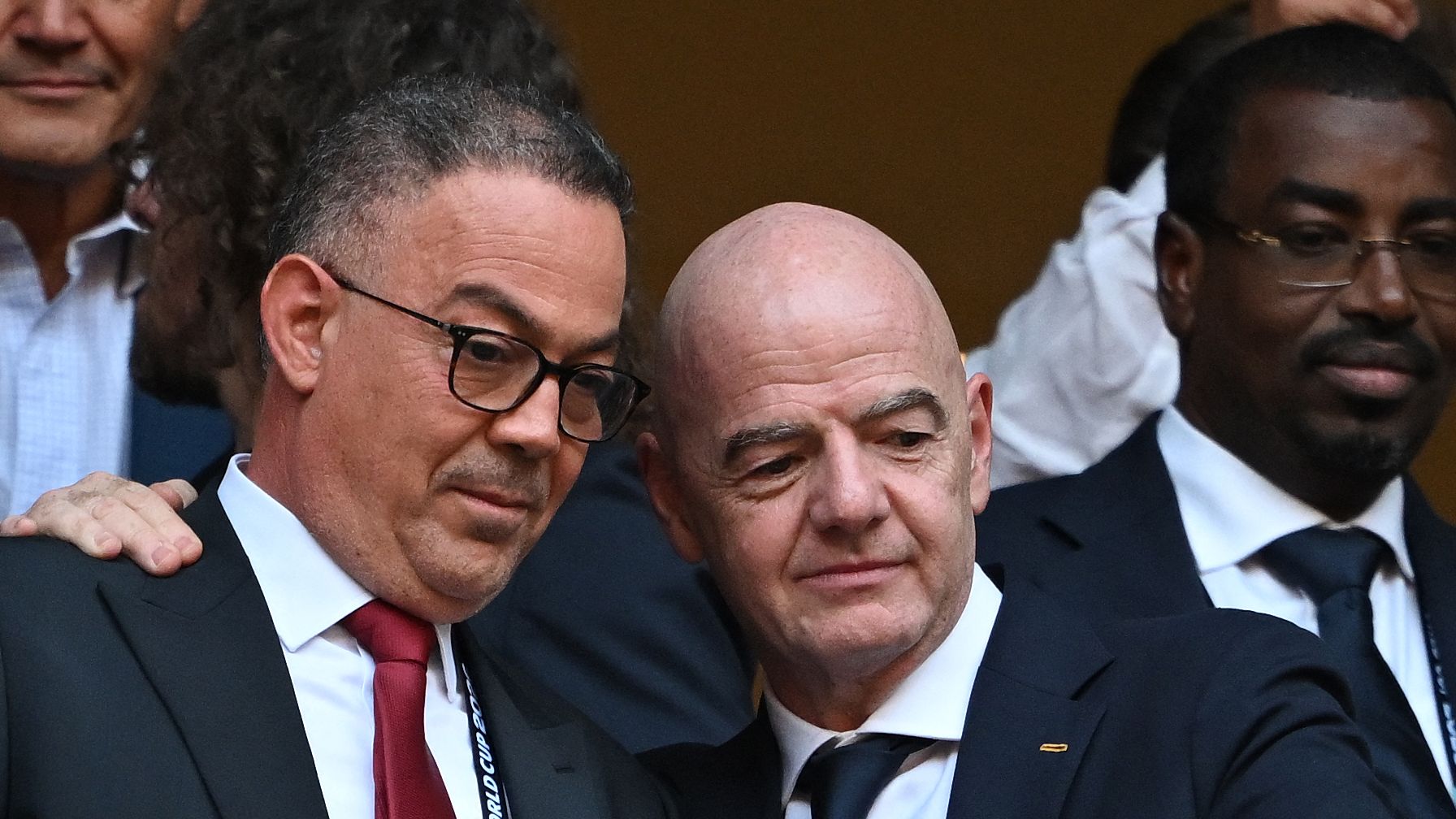
Image from AFP
__AFP_C2GU3NW-1784304300
Fans bear the biggest burden
The public bears the biggest financial burden due to ticket prices and the 'dynamic pricing' policy.
Even President Donald Trump stated he 'would not pay' when asked about a $1,000 ticket for America's opening match against Paraguay.
Tickets for the final at MetLife Stadium were officially priced at $32,970, while their value in resale markets exceeded $2 million.
Fans also suffered from crazy jumps in prices for flights, food, accommodation, and public transport tickets, such as the New Jersey Transit train whose ticket jumped from $12.9 to $150 before being reduced after protests.
Alexander Budzier, fellow at Oxford University and CEO of Oxford Global Projects, confirms that the long-term economic benefits for the 16 cities are not realized; they see a decline in visitors from other sectors who avoid the tournament chaos.
He argued that the employment boom is temporary and in low-wage jobs; the boom 'provides jobs but does not create wealth.'
Despite FIFA's estimates of adding $41 billion to the global economy and $17 billion to the US, and providing 185,000 jobs, due to reliance on existing stadiums and infrastructure, Budzier believes that the absence of construction development projects means 'no economic benefit from development.'
Hotels make do with momentum on limited match days
The fan momentum did not translate into full occupancy rates throughout the World Cup period; demand was limited to specific match days.
The American Hotel and Lodging Association accused FIFA of booking huge blocks of rooms in advance, creating 'artificial demand.'
Expert Labour points out that 80% of hotel operators in the US reported by April that bookings had fallen short of expectations.
The percentage was 66% in New York and nearly 80% in Seattle, describing the tournament as a 'forgettable event.'
Original source: Aleqtisadiah




Comments (0)
Be the first to comment.