Attack on Two Tankers Near Oman Threatens Southern Route in 'Hormuz'
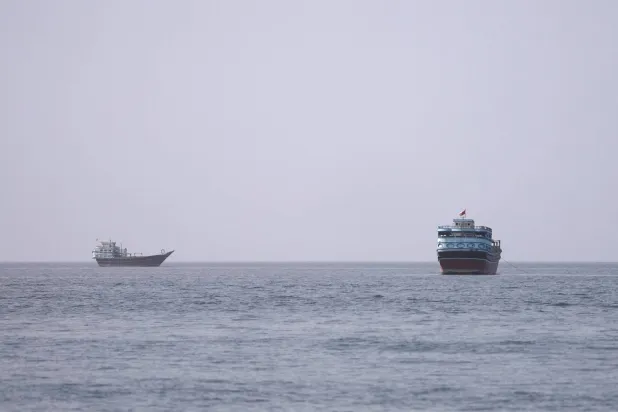
A ship caught fire off the Omani coast on Monday after being hit by an unknown projectile, in an incident that widened the scope of the naval confrontation in the Strait of Hormuz.
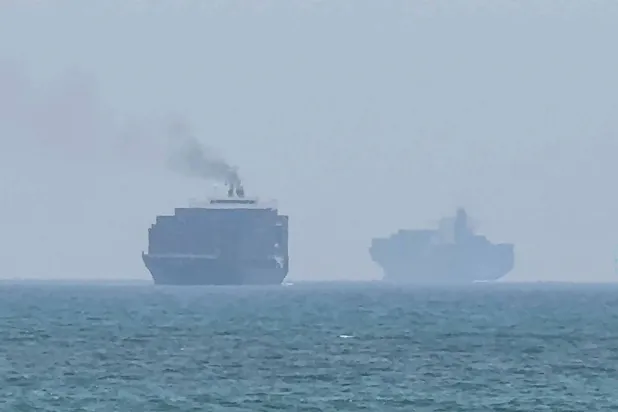
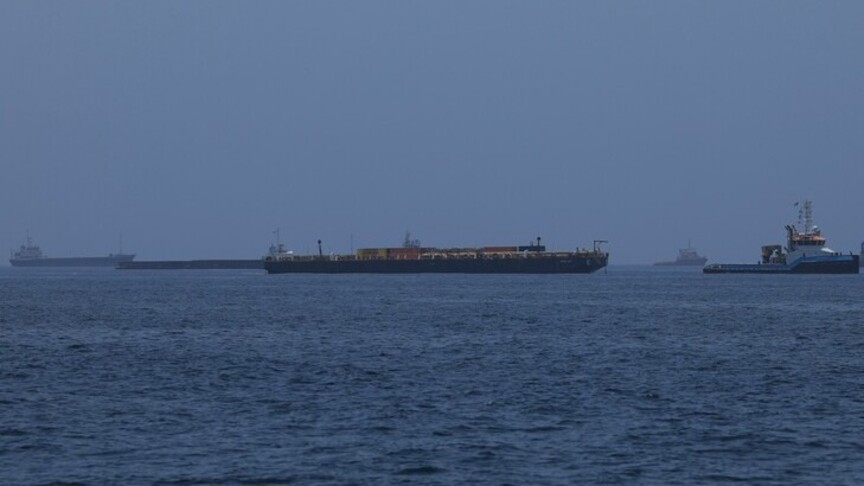
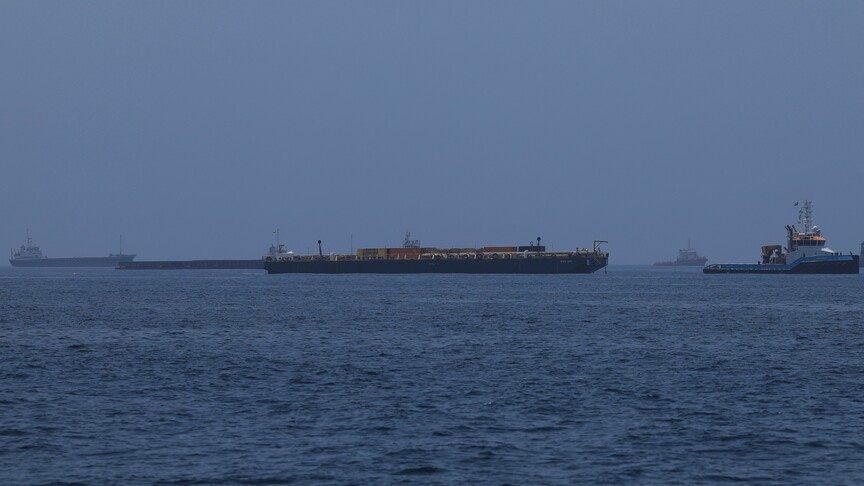
Two oil tankers operated by a Greek company were hit by unknown projectiles off the Omani coast on Monday in two nearly simultaneous attacks on the southern route in the Strait of Hormuz, a day after the Revolutionary Guard announced it had disabled two tankers trying to cross the same area. Dynacom Tankers said the Maltese-flagged tanker Kafoumaleas was hit by two projectiles, causing a fire in the engine room and prompting its captain to evacuate after activating the fire suppression system.
It added that Omani authorities found all crew members and brought them safely ashore, while the tanker remained adrift at sea pending control of the fire and damage assessment.
In a separate statement, the company announced that another tanker it operates, the Liberian-flagged Achilleus, was hit by an unknown projectile. It said crew members are safe and the vessel completed mooring for inspections, with no marine pollution recorded.
The Achilleus is a very large crude carrier capable of carrying about two million barrels of oil.
The Greek maritime security company Marisecs said the two tankers were attacked around the same time as they were passing through a southern route in the strait facilitated by the United States.
It was not clear whether the two tankers were the same vessels that the Revolutionary Guard said were hit by two explosions and stopped sailing after attempting to use what it described as an 'unsafe southern route.'
The Omani Route
On Sunday, the Revolutionary Guard announced that four ships attempted to cross the strait without coordinating with Iranian authorities, and that two ships stopped after being involved in an 'incident,' while the other two turned back.
According to the Iranian account, the ships attempted to use a route near the Omani coast, which the United States encourages commercial vessels to follow to avoid restrictions imposed by Tehran on transit.
Ships had been using the route near the Omani coast to avoid Iranian restrictions in the northern part of the strait, but a ship being hit there showed that the risk of attacks extends to this route.
Tehran insists that ships wishing to cross the strait must adhere to the route and timing determined by Iranian authorities. In contrast, Washington says the Strait of Hormuz is an international waterway and Iran has no right to unilaterally impose restrictions on navigation there.
0 seconds of 0 secondsVolume 90%
Press shift question mark to access a list of keyboard shortcuts
00:00
00:00
00:00
Iranian Foreign Ministry spokesman Ismail Baghaei said on Monday that Tehran 'will not allow this waterway to be misused again to threaten Iran's security and national interests.' He added that Iran is 'determined to take necessary measures' to defend its sovereignty and protect its interests.
The memorandum of understanding signed by Washington and Tehran in June stipulated the reopening of the strait in exchange for the United States lifting the blockade on Iranian ports. But disagreement continued over the transit route and management of ship traffic. Tehran spoke of imposing 'service fees' on ships, which the United States rejected.
Decline in Ship Traffic
Data from the London Stock Exchange Group showed that only four ships crossed the Strait of Hormuz on Sunday, compared to eight ships the previous day, indicating a sharp decline in traffic.
The data indicated that three product tankers and one very large crude carrier entered the strait since Friday to load cargo, despite Iranian warnings and ongoing military operations in the area.
Iran had closed the strait during the war that began with a US-Israeli attack on it on February 28. Before the war, about a fifth of global oil and liquefied natural gas supplies passed through the waterway.
The June memorandum temporarily reopened the strait, but the collapse of the ceasefire and renewed strikes brought restrictions and attacks on ships back to the forefront of the confrontation.
The US Central Command (CENTCOM) said its strikes on Iran, for the ninth consecutive night, targeted military command centers, air defense and coastal surveillance sites, naval capabilities, and missile and drone launch sites.
It added that the operations aim to 'undermine' Iran's ability to attack commercial vessels in vital shipping lanes linked to the Strait of Hormuz.
The strikes coincided with the United States reimposing a naval blockade on Iranian ports to halt crude oil exports. The US military said it had diverted six ships and disabled another since the blockade began.
US Secretary of State Marco Rubio said Iran uses its control over parts of the strait as 'leverage against the world' and called on other countries to increase their contribution to protecting navigation, whether by providing equipment or financial support.
He added that the United States will continue to take what it deems necessary to protect global shipping, and that the memorandum of understanding cannot remain in effect if Iran continues to violate its terms.
Brent Exceeds $90
Brent crude briefly jumped above $90 a barrel before later retreating to around $88.55, following Iranian statements indicating continued contacts through mediators and the possibility of returning to negotiations.
Prices had fallen and stabilized after the signing of the memorandum of understanding, before rising again with the collapse of the agreement and the resumption of strikes and attacks on ships.
Monday's incident raised fears of a reduction in available routes for tankers, after the danger extended to the route near Oman, which ships had been using to avoid Iranian restrictions on the other side of the strait.
Original source: Asharq Al-Awsat



Comments (0)
Be the first to comment.