Research team develops drone less visible to the human eye through rapid spinning
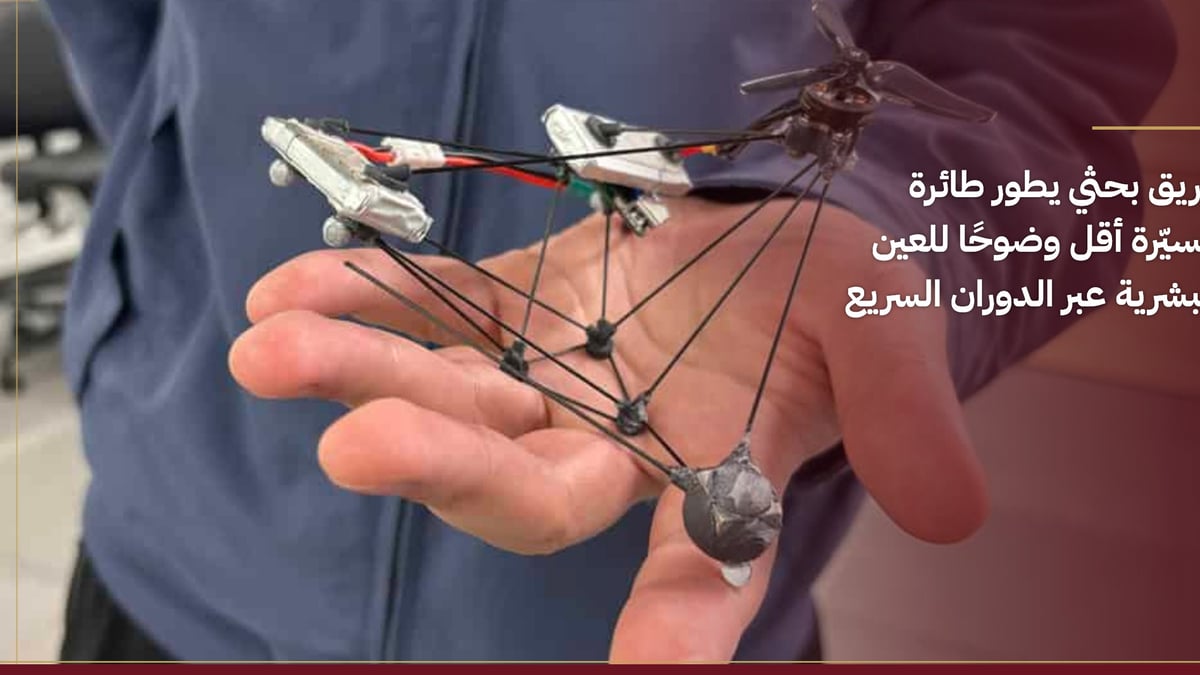
A research team at Northwestern University has developed a prototype drone called Phantom Twist that spins rapidly to become less visible to the human eye, achieving a reduction in detectability through motion blur rather than camouflage.
A team of researchers at Northwestern University in the United States has succeeded in developing a new experimental drone called Phantom Twist, which relies on rapid spinning to make it less visible to the human eye. This innovation aims to reduce the detectability of drones by adopting a different approach from traditional camouflage methods.
According to the Romanian scientific website ZME Science, the drone spins at speeds of up to 25 revolutions per second, causing its components to become visually blurred and appear as a sort of haze during flight, taking advantage of the way the human eye processes fast-moving objects.
Different design and simulation models
The researchers explained that the new design does not rely on camouflage paint or changing the drone's color, but on redistributing components so that continuous spinning reduces its visual clarity. Computer models simulating human perception showed that the Phantom Twist could be about 10 times less detectable than a traditional quadcopter, but practical tests on volunteers have not yet been conducted.
In the same context, researcher Emma Alexander, a specialist in computer vision, pointed out that the human eye requires a period of time to integrate visual signals, which makes rapidly rotating objects appear blurred and lose detail, and this is the principle on which the design is based.
Technical details and preliminary results
The Phantom Twist design differs from traditional drones, as it uses a single engine and a single propeller, while the drone's body spins in the opposite direction to the propeller to provide stability. The control system adjusts thrust at specific moments in each rotation to steer the drone during flight.
The team added that they used artificial intelligence techniques to generate approximately 20,000 possible designs, taking into account the distribution of batteries, circuit board, motor, propeller, and weights, with the drone's weight not exceeding 40 grams, while maintaining a rotation speed between 15 and 25 revolutions per second to achieve the desired visual effect.
Each design underwent digital simulation from different angles, and images of the drone were blended with over 100 real-world scenes to measure its impact on the background. The top 500 designs were optimized, reducing the average detectability by 12%, and the best model achieved the lowest visibility score among all tested models.
For its part, the team explained that three prototypes of the drone were tested in the lab, flying for about 10 minutes with an average positioning error of 3 centimeters. Long-exposure photographs showed good agreement with simulation results, as the improved model appeared as a transparent, faint blob compared to the traditional design.
Future applications and challenges
Researchers believe the drone could be useful in wildlife research, as its reduced visual clarity may limit disturbance to animals during observation. However, the team acknowledged that the propeller sound is still audible, making the drone only less visually conspicuous without being completely silent.
In the same context, researchers noted that this project is part of broader efforts to develop less detectable robots, such as transparent robots or those capable of changing colors, but the Phantom Twist relies on motion as a means of concealment rather than traditional camouflage.
The team is scheduled to present the study results at the Robotics: Science and Systems conference hosted in Sydney, Australia.
Discuss the news with artificial intelligence
Original source: Ajel.sa


Comments (0)
Be the first to comment.