The Nile Recedes... Sudan Faces a Water Test

The decline in the water level of the Nile in Sudan has turned into a crisis that caused drinking water plants to go out of service and raised fears of it extending to the agricultural season.
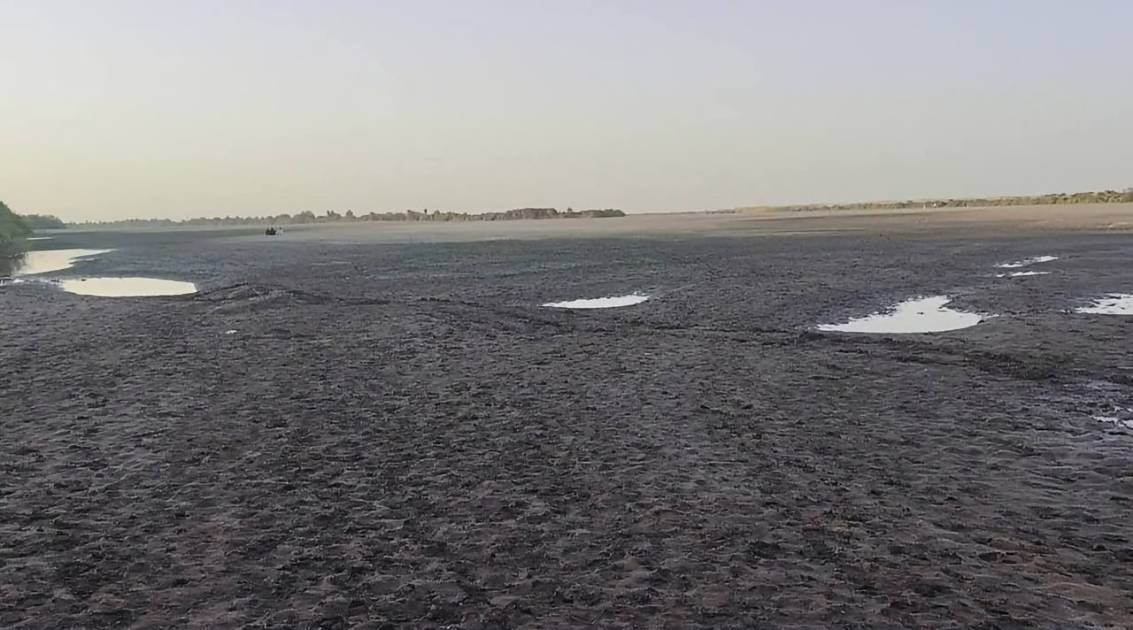
This summer’s receding of the Nile was not merely a seasonal change in the river’s levels, but turned into a crisis that affected the lives of hundreds of thousands of Sudanese, after drinking water plants broke down and supplies declined in several areas, amid fears that the repercussions would extend to the agricultural season and food security.
Despite government assurances that the decline is temporary and the water situation remains under control, experts say what is happening reflects new complexities in water resource management, imposed by the operation of regional dams and the lack of sufficient coordination over Nile flow management, along with internal challenges that have exacerbated the fragility of water infrastructure.
Official reassurances
The General Administration of Reservoirs at the Ministry of Agriculture and Irrigation affirmed the stability of the water situation in the country, noting that the inflows of the White and Blue Niles remained above their averages until mid-July. It explained in an official statement that the decline in Nile levels between the 7th and 10th of July was temporary, attributing it to a reduction in water discharge from the Grand Ethiopian Renaissance Dam (GERD), which affected the inflow to the Roseires and Sennar reservoirs and led to a limited drop in water levels at several stations. The ministry stressed that these changes were addressed through the technical operation of the reservoirs, announced the formation of a high-level committee to continuously monitor the water situation, and emphasized that reservoir management is conducted on scientific bases to ensure stable drinking water and irrigation supplies and support the agricultural season.
The receding Nile waters caused many water stations to go out of service (Khartoum State's Facebook page)
But on the ground, the drop in levels quickly affected drinking water services, especially in Khartoum State, where intake pumps at the al-Salha water stations in southern Omdurman and the northern Khartoum North rural area stopped, leading to supply shortages in several neighborhoods and villages. Recent images captured by the European satellite Sentinel-2 showed a clear retreat in the Nile's course over one month, with the waterway shrinking and vast areas that had been submerged emerging, which temporarily took the main al-Salha water station out of service.
The official spokesman for the Khartoum State government, al-Tayeb Saad al-Din, told Asharq Al-Awsat that the failure of the two stations affected water supplies for about 600,000 citizens, pointing out that the authorities managed to restart them after urgent measures, while technical work continues to implement permanent solutions to ensure stable water supply.
Dams... a more complex equation
International expert and former advisor to the Ministry of Irrigation Ahmed al-Mufti believes that the current decline is linked to the filling and operation of the GERD, explaining that the dam retains part of the natural inflow during filling stages, while later releasing large amounts of water could lead to flood risks if done without coordination with Sudan. He added that Sudan previously managed its reservoirs according to the natural flows of the Nile, but the unilateral operation of the dam changed this equation, stressing that the solution lies in a binding legal agreement regulating the filling and operation of the dam and ensuring data exchange and prior notification among the concerned countries.
The GERD causes the Nile's waters to recede in Sudan (Reuters)
For his part, irrigation and water resources expert al-Sadiq Sharafi believes that the crisis is not only due to the GERD, but also related to Sudan's location between the High Dam in Egypt and the GERD in Ethiopia, which has made water flow management largely outside its borders, amid limited coordination and information exchange.
He explained that the seasonal decline in Nile levels has been occurring earlier since the construction of the GERD, but the impact on some water stations is also due to deficiencies in their design and their unsuitability for the new changes in levels, stressing that water resource management in the Nile Basin has become more complex, making data exchange and coordination among basin countries a necessity, not an option.
He also called for dealing with the dams issue from a broader perspective, not limited to the GERD but also including the effects of the High Dam, noting that reducing its storage volume could help restore parts of the submerged agricultural land in the Halfa area and reduce flooding areas within Sudan.
Fears over the agricultural season
The repercussions of the decline in levels are not limited to drinking water, as specialists warn of its impact on the agricultural season, especially with the decrease in water inflow to the Sennar and Roseires reservoirs. The editor-in-chief of Sawt al-Fallah newspaper and agricultural affairs enthusiast Ayoub Wad al-Salik told Asharq Al-Awsat that the continuation of the crisis could lead to a reduction in irrigated areas, a food gap, and a rise in grain prices by more than 40 percent if levels continue to decline, noting that an improvement in water inflow would limit these risks.
These challenges are compounded in the Gezira Scheme, which extends over about 2.2 million feddans and is the largest irrigated agricultural project in Sudan. It suffers from significant deterioration in irrigation canals and weak water flow due to the damage caused by the ongoing war since April 2023, which reduces its capacity to absorb any new shocks in water supply.
Beyond the crisis
Observers believe that the crisis of low Nile levels has exposed the fragility of Sudan's water resource management system, where regional factors related to dam operation have intertwined with internal challenges including weak water infrastructure and the effects of the war on irrigation facilities and services. While the government asserts that the situation is under control and the decline was temporary, experts warn that the recurrence of such events may become more common unless regional coordination and data exchange mechanisms evolve, along with the modernization of water station infrastructure and irrigation networks.
In a country that relies on the Nile as the main source of drinking water, irrigation, and electricity generation, fluctuations in levels are no longer just a technical matter but have become an issue directly linked to water and food security and economic stability. Therefore, the need is more urgent than ever for a comprehensive vision for managing water resources, combining scientific planning, regional cooperation, and investment in infrastructure, to prevent seasonal changes from turning into crises affecting the lives of millions of Sudanese.
Original source: Asharq Al-Awsat



Comments (0)
Be the first to comment.