Beyond Syria's Unity
Syria has experienced division, unity, partition, and union with others. During the French mandate, it was divided into four states: the State of Damascus, the State of Aleppo, the State of the Alawites, and the State of the Druze. But this division did not withstand the will of the people across Syria and the resolve of its leaders at that time, most notably Sultan Pasha al-Atrash and Sheikh Saleh al-Ali.
Syria is destined to be one, unified in territory, people, and institutions. But control over the people and institutions makes geographical unity formal and institutions mere empty structures. The issue is not centralization or decentralization. The issue is which centralization and which decentralization. Centralization without power-sharing that includes all shades of the political spectrum is tyranny and an invitation to explosion. Decentralization on non-geographical grounds is a return to pre-state conditions. Both, without democracy and citizenship, are merely a struggle over "booty" distributed among "tribes" according to each's strength or monopolized by the strongest.
Syria has experimented with many forms, systems, separation, and annexation before and after independence. It is fundamentally captive to a duality of national and pan-Arab (qawmi) thought in ideology and political action. On one hand, it is a "qutr" (individual state) alongside other "aqtar" (states) within a nation that will not become a homeland except through the project of Arab unity and the establishment of a "nation-state." On the other hand, it sees itself as the center of action for the nation and the "beating heart of Arabism," as President Gamal Abdel Nasser called it. The irony is that calls for the "nation-state" have become the model today at the expense of calls for the state-nation, whether Arab, Islamic, or Syrian nationalist, while Syria has fallen short in building a nation-state.
That is because Syria has known division, unity, partition, and union with others. During the French mandate, it was divided into four states: the State of Damascus, the State of Aleppo, the State of the Alawites, and the State of the Druze. But this division did not withstand the will of the people across Syria and the resolve of its leaders at that time, most notably Sultan Pasha al-Atrash and Sheikh Saleh al-Ali. After independence, Syria rushed in 1958 into a merger union with Egypt that was short-lived, ending in the fall of 1961. After the fall of the union and the Baath Party's rise to power in Iraq and Syria, attempts were made to establish a tripartite federal union between Egypt, Syria, and Iraq, but it ended before implementation. Even attempts at unity between Syria and Iraq failed and turned into hostility between what was called Syrian Baath and Iraqi Baath.
As for the long era of the Assad family, Syria remained unified through violence and repression in the face of bloody uprisings that were crushed with horrific massacres, as happened in Hama, and then after 2011, in the Syrian war, it divided into regions, with four armies and militias of all kinds controlling the land. One of the theories that spread during the uprisings of the so-called "Arab Spring" is that the outcome in Syria was the opposite of what former regime president Bashar al-Assad wanted to achieve.
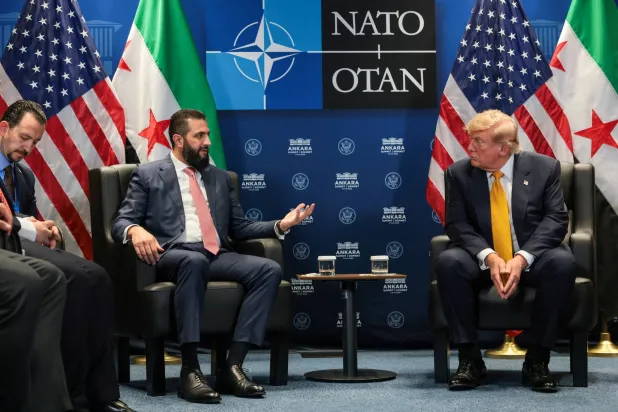
He rushed to use violence against peaceful protesters, betting on the "militarization" of the uprising, because militarization inevitably leads to "extremism and sectarianism," thereby pushing out moderates and leaving the field to extremists, presenting the Arab and Western worlds with a specific choice: the regime or fundamentalism, hoping to remain in power. But the game ended with the collapse of the regime and Assad's flight, and with the U.S. and Turkey backing Hay'at Tahrir al-Sham, led by Abu Mohammed al-Julani, before his real name Ahmed al-Sharaa was revealed and he assumed the presidency.
The expected step after Damascus regains east of the Euphrates and reaches an understanding with the SDF is to find a settlement for the issue of Suwayda and the issue of the western coast. If regaining east of the Euphrates required a mix of military action and political agreement under U.S. and Turkish supervision, then the settlement in Suwayda and the coast must be purely political, or not at all.
What comes after the settlement is more important. If President al-Sharaa has excelled in opening Syria to the outside world and the outside world to Damascus after a long isolation and sanctions, the challenge is to complete the external opening with an internal opening. Not with speeches but with actions. Not with promises but by building what is necessary in the transitional period.
The minimum is a necessary partnership in central power and flexible performance in decentralized administration. A clear vision for a liberal economic system, modern investment laws, and a fair, transparent, independent judiciary. Otherwise, investments will remain on paper. Most importantly, drafting a constitution and a political parties law to bring politics back to life after its long "desertification," so that people know what lies at the end of the transitional period.
Read more
Who is behind attempts to portray Syria as unsafe?
Syria: The cell responsible for the two bombings during Macron's visit is linked to ISIS
Trump informs al-Sharaa of his decision to remove Syria's designation as a state sponsor of terrorism
More importantly, it is ending the reluctance even to use the term democracy before building democracy. It is addressing people's urgent financial, economic, and social issues in a country where 90 percent of the population lives below the poverty line.
All who visited the book fair in Damascus witnessed that all kinds of books were allowed, but they noticed that women made up more than half of the fair's visitors, while there was not a single woman among the workers or among those giving lectures.
Praise for openness to dialogue and discussion recalls a saying by the late Lebanese Prime Minister Dr. Salim al-Hoss: "In Lebanon, there is a lot of freedom and little democracy."
The equation in Syria, until further notice, is little freedom and no democracy. In both cases, there is a problem.
Original source: Independent Arabia

Comments (0)
Be the first to comment.