Israeli municipality opens shelters as 'risk of rockets from Iran increases'
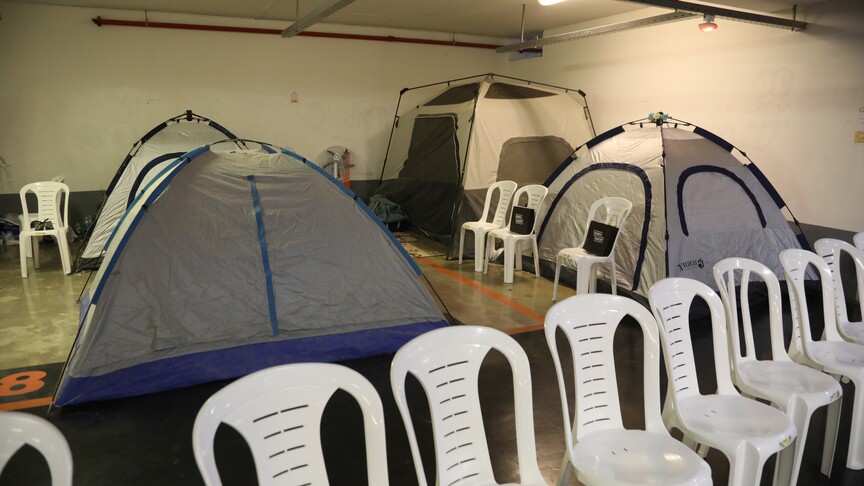
Ramat Gan mayor said assessment indicates increased risk of rocket fire from Iran over the weekend.
JERUSALEM / Anadolu
The Ramat Gan municipality announced on Thursday the opening of all shelters in the city, against the backdrop of what it described as an increased risk of rocket fire from Iranian territory.
This measure comes amid escalating tensions between Israel and Iran following recent US attacks.
In a Facebook post, Mayor Carmel Shama clarified that the decision to open shelters includes all shelters in the city, which is located in the greater Tel Aviv area, and said: 'We have decided to open all shelters in the city.'
He added: 'An assessment was conducted indicating an increased risk of rocket fire from Iran over the weekend, and this risk is now present.'
Shama stressed that caution is necessary despite the cost, saying: 'Despite the cost of opening them, caution is necessary, and I hope they will not be needed.'
He noted that he did not decide to open the shelters at the request of the Israeli army, indicating that the decision was taken unilaterally.
The Israeli Broadcasting Authority reported on Wednesday that Israel raised its alert level in anticipation of a possible direct confrontation with Tehran, amid the US escalation against Iran. Its report said: 'Israel raised its alert level in anticipation of the possibility of entering into a direct confrontation with Tehran, against the backdrop of the United States escalating its attacks against Iran.'
It added: 'US President Donald Trump's threat to target a national infrastructure facility for every Iranian response would increase the likelihood of Israel's involvement in the confrontation, as well as the possibility that Iran would decide to launch rockets toward Israeli territory.'
The Israeli Broadcasting Authority reported that 'contacts are being made to hold a meeting between Prime Minister Benjamin Netanyahu and US President Donald Trump next week.'
It said: 'The United States informed Israel that it intends to escalate its attacks against Iran in the coming days, and that it will use, for the first time in the current round of escalation, heavy bombers to carry out the raids.'
It added: 'The security coordination between Washington and Israel aims to enable Israel to prepare for the possibility that Iran decides to escalate the confrontation and launch rockets toward Israel, a step that could in turn lead to the resumption of Israeli attacks inside Iran.'
For about two weeks, the United States has been launching successive waves of strikes inside Iran, while Tehran carries out attacks on ships, facilities, and military bases it claims are American in several countries in the region.
This comes despite Washington and Tehran signing a memorandum of understanding on June 18 that included a ceasefire and the start of negotiations to reach a broader agreement.
However, the US president announced on July 8 the end of the ceasefire, following Iran targeting three ships in the Strait of Hormuz, prompting Washington to resume its strikes inside Iran, amid escalating responses from Tehran in the region.
Washington demands 'ensuring freedom of navigation in the Strait of Hormuz,' while Tehran, as a littoral state, insists on imposing a mechanism to regulate ship passage through the strategic waterway, exacerbating fears of disruption to oil and gas exports from the region.
Israel previously participated with the United States in two waves of attacks against Iran; the first began on June 13, 2025, and Tehran responded by bombarding several sites inside Israel with rockets and drones, and the confrontation lasted 12 days.
The second wave began on February 28, 2026, when the US-Israeli coalition launched a large-scale air and naval attack targeting the capital Tehran and other Iranian cities, and assassinated Iranian Supreme Leader Ali Khamenei and a number of officials, while Iran responded by bombarding Israel with rockets and drones.
This confrontation came amid escalating tensions and the collapse of indirect negotiations over Iran's nuclear program.
The unilateral decision of the Ramat Gan municipality reflects a state of anticipation in Israeli cities for the possibility of a military confrontation. These developments come at a time when US strikes against Iran are escalating with the use of heavy bombers for the first time. The security coordination between Washington and Tel Aviv indicates preparation for a possible Iranian response. The anticipated meeting between Netanyahu and Trump is expected to discuss the next steps in this matter.
Original source: Anadolu Agency

Comments (0)
Be the first to comment.