Pakistan calls for adherence to 'Islamabad' memorandum between US and Iran and avoiding further escalation
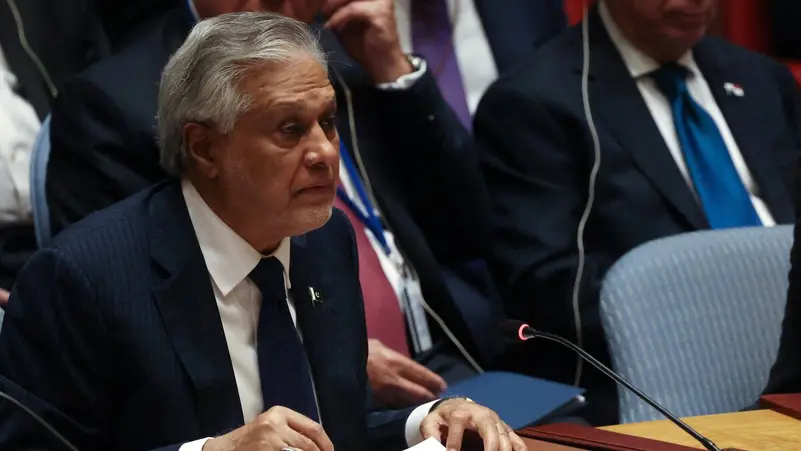
Deputy Prime Minister and Foreign Minister of Pakistan, Mohammad Ishaq Dar, emphasized on Saturday the importance of adhering to the ceasefire commitments stipulated in the 'Islamabad' memorandum of understanding, calling for avoiding any steps that could lead to further escalation in the region.
This came during a telephone call received by Ishaq Dar from the Foreign Minister of Kuwait, Sheikh Jarrah Jaber Al-Ahmad Al-Sabah, during which the two sides discussed the latest regional developments amid escalating tensions.
During the call, the Kuwaiti Foreign Minister expressed his country's deep concern over the continued attacks targeting Kuwaiti territory, expressing hope that all parties would exercise maximum restraint and that the memorandum of understanding reached in Islamabad would be fully implemented.
For his part, 'Ishaq Dar' affirmed the urgent need for de-escalation, stressing the necessity of respecting the sovereignty and territorial integrity of states, and confirming that maintaining regional peace and security should remain a top priority.
These contacts come at a time when Iran announced on Saturday the suspension of all its commitments under the memorandum of understanding concluded with the United States, accusing Washington of violating its pledges and resorting to what it described as 'aggressive acts.' The Iranian Deputy Foreign Minister for Legal and International Affairs, Kazem Gharibabadi, said that his country was engaged in negotiations with the United States when Washington, according to his expression, carried out military measures that constitute a direct violation of the obligations under the memorandum of understanding.
The Iranian decision represents a new blow to the understandings reached with Pakistani mediation, which aimed to halt military operations and create conditions for a broader settlement between Washington and Tehran. The memorandum of understanding had been associated with attempts to consolidate calm and reopen the Strait of Hormuz to international navigation, but disagreements over the interpretation of obligations and implementation mechanisms continued to threaten the agreement since its conclusion.
Tehran's announcement of suspending its commitments came after the expansion of the scope of US strikes inside Iran, and the exchange of attacks between the two sides, which led to a rapid decline in the chances of resuming political contacts.
Meanwhile, Kuwait on Saturday accused Iran of pursuing 'systematic aggressive behavior' targeting civilian objects and critical infrastructure, after oil facilities, power and water stations, as well as military and security sites, were subjected to missile and drone attacks that resulted in injuries, material losses, and fires.
Original source: Al-Mowaten




Comments (0)
Be the first to comment.